- All
- African projects
- assessment
- assessment selected projects
- Assessment selected projects 2
- Assessment selected projects 3
- Assessment selected projects 4
- ASTRA
- Cost Benefit Analysis
- Electric mobility and ITS
- MOMOS
- planning
- planning selected projects
- planning selected projects 2
- planning selected projects 3
- planning selected projects 4
- planning selected projects 5
- projects
- Railways projects
- research
- research selected projects
- research selected projects 2
- research selected projects 3
- studies
- studies selected projects 1
- studies selected projects 2
- studies selected projects 3
- studies selected projects 4
- studies selected projects 5
- TRTingegneria
- TRUST
- urban mobility
- Preparation of the Urban Mobility Plan of the city of Prato in Italy TRT, as a result of a tendering procedure, has been selected by the City of Prato to support their offices in the preparation of the SUMP. The Plan takes as reference methodology the “SUMP guidelines” prepared by the EU Commission (with the contribution, among others, of TRT). The SUMP process has been developed in four steps: background analysis of the mobility-related framework and its environmental, social and economic impact in Prato; identification of the strategies for the construction of the SUMP scenarios, as a result of the background analysis, the selected objectives and the priorities raised through public listening (surveys and thematic/territorial focus groups); design of two different scenarios: reference solution and SUMP scenario – the latter is characterised by a set of coherent transport measures aimed at achieving specific objectives; evaluation procedure, implementing a ex ante transport model (AIMSUN) and a policy evaluation procedure (MOMOS) derived from the Urban Road Map 2030 tool. The SUMP of Prato has been presented to the local community, stakeholders and decision makers in October 2016. The Plan has been approved by the City Council in June 2017. TRT was also responsible of the drafting of the Parking Master Plan and the Urban Traffic Plan of the city of Prato In 2022, TRT also drafted Prato’s e-Mobility Plan and the SUMP monitoring report in accordance with the indicators of DM 396 of 28/08/2019. For more information (Only available in italian) Official SUMP webpage hosted in the website of the Municipality. It contains all the information related to the SUMP process in Prato Webpage where project deliverables and annexes can be found Link to download the final SUMP document
- Financial and business model for a bike station to be realised next to the «Milano Lambrate» railway station The study focused on the definition of a financial and business model for the set-up of a bike station (a safe parking for bicycles, accompanied and supplemented by complementary activities), with particular reference to the case of Lambrate railway station, a strategic public transport node in the city of Milan. The financial and business model has been developed in order to maintain a modular and parametric approach, as well as to provide the transferability of results to other similar contexts.
- EasyConnecting – Feasibility analysis of two new maritime services between the port of Ravenna and IPA countries TRT conducted a study on the feasibility of two new services. Analysis of the Ro- Ro traffic at national level, in the Adriatic Sea and from the port of Ravenna. Identification of potential routes between ports of Ravenna and IPA area (Adriatic Cross-border Cooperation Programme), focusing on the Albanian ports. Investigation of the potential of new scheduled services based on the evaluation of the operating costs of new services as compared to the use of a Ro-Ro ship. Evaluation of the economic and operational feasibility of the two liner services and drafting a business plan guidelines for the two selected services
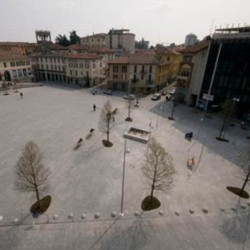
- Urban Traffic Plan of Cantù (Italy) and its update TRT has been selected by the Municipality of Cantù in order to draw up the Urban Traffic Plan for the city. Cantù, 38,000 inhabitants, is located in the hilly suburbs of Como, North of Milan. In the period 2008-2011, TRT activities have been related to: the reorganization of the road system, the safety improvement of the road network, the improvement of the modal interchange at the railway station. After drafting the Plan, TRT has assisted the Municipality throughout the approval process. Later, in 2014, the City Council has set as its ambitious goal the creation of a Limited Traffic Zone (LTZ) in the city centre. The activity of TRT focused the evaluation of the technical feasibility of the proposal made by the Municipality, as well as the definition and assessment (with the application of a microsimulation traffic model) of alternative scenarios. After the selection of the selected scenario, the Plan has been updated and then approved by the Municipality on 16/03/2017.
- Study for the creation of the integrated intermodal logistic system in Port of Taranto back area The action, co-funded under the TEN-T programme of the European Commission, completed a study for the enhancement of the existing intermodal facilities in Ferrandina as a pilot phase for the re-organisation of the back-port Logistic System of the Port of Taranto. The action included all the necessary steps from market feasibility studies to final planning and the attainment of building authorisations. The study also assessed the feasibility of financing such works through the establishment of a PPP scheme. TRT as main technical coordinator of the action, provided different types of supports: technical and administrative/financial reporting, organisation of meetings.
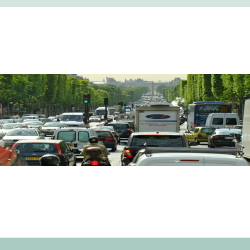
- Study on Urban Mobility – Assessing and improving the accessibility of urban areas This study in urban accessibility has been designed in order to advance the understanding of urban accessibility in order to improve the functioning of urban areas and make the transport system in Europe’s urban areas more efficient. The study, carried out by Ricardo and TRT, comprises various tasks. TRT has played a major role in estimating European urban road congestion costs and comparing relative efficiency of urban passenger transport modes. The welfare economic approach is used to define a measure of congestion cost in terms of deadweight loss in cities. The estimation of congestion costs per year (per capita and at urban level) is based on available congestion indexes for a sample of cities and other relevant information (population, value of time, share of car mode split, car occupancy factor). Delay congestion costs were also estimated. The relative performance of different urban transport modes was assessed in relation to capacity; energy use; CO2 emissions and user cost. The above metrics were assessed for private modes (car and motorcycle) and public transport modes (bus and rail). Also, metrics was assessed for metropolitan areas and medium cities, and for peak (or congested) traffic and off-peak (or uncongested) traffic.
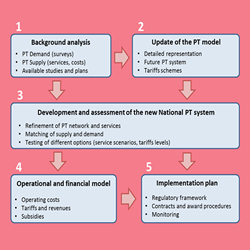
- Development of the National Public Transport System for the Hashemite Kingdom of Jordan TRT, already responsible along with German partner PTV Transport Consult for the preparation of the Jordan National Transport Strategy, has been commissioned for the study to develop and improve the public transport system of Jordan. The project includes: surveys on site focussed on transport demand, supply, costs borne by local operators, fare schemes and subsidies, the definition of a programme for intercity, regional and urban services of the whole Kingdom, a proposal to reform the whole sector, including provision of subsidies, contracts and award procedures. The development of the plan is supported by the multimodal transport model, based on the VISUM software.
- Technical assistance for the implementation of the EA SEA-WAY (Europe Adriatic Sea Way) project, funded under the IPA Adriatic cross-border cooperation programme The general objective of the EA SEA – WAY project is to improve of the accessibility and the mobility of passengers across the Adriatic area and its hinterland, through the development of new cross-border sustainable and integrated transport services and the improvement of physical infrastructures related to those new services. TRT is involved in the project by supporting the Client in relation to the following activities: coordination of the cross-border institutional committee; participation of experts in the thematic cross-border and local working groups; drafting of a cross-border and a local action plans for the project thematic priorities; designing of an Adriatic strategy aiming at developing sustainable passenger transport.
- Update of the railways and logistic masterplan in the Verona area (Italy) The freight rail infrastructure and logistics masterplan in the Verona area (Italy) aims at providing a framework for the evaluation and design of the Isola della Scala intermodal terminal, in consideration of the economic and programmatic situation updated to year 2014. TRT is part of the working group and was responsible for the rail and road infrastructure systems analysis, related to both demand and supply.