- All
- African projects
- assessment
- assessment selected projects
- Assessment selected projects 2
- Assessment selected projects 3
- Assessment selected projects 4
- ASTRA
- Cost Benefit Analysis
- Electric mobility and ITS
- Local Public Transport
- MOMOS
- planning
- planning selected projects
- planning selected projects 2
- planning selected projects 3
- planning selected projects 4
- planning selected projects 5
- projects
- Railways projects
- research
- research selected projects
- research selected projects 2
- research selected projects 3
- studies
- studies selected projects 1
- studies selected projects 2
- studies selected projects 3
- studies selected projects 4
- studies selected projects 5
- TRTingegneria
- TRUST
- urban mobility
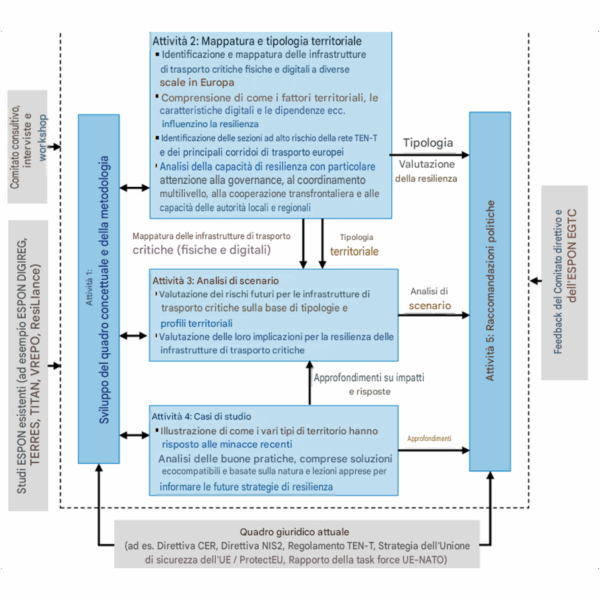
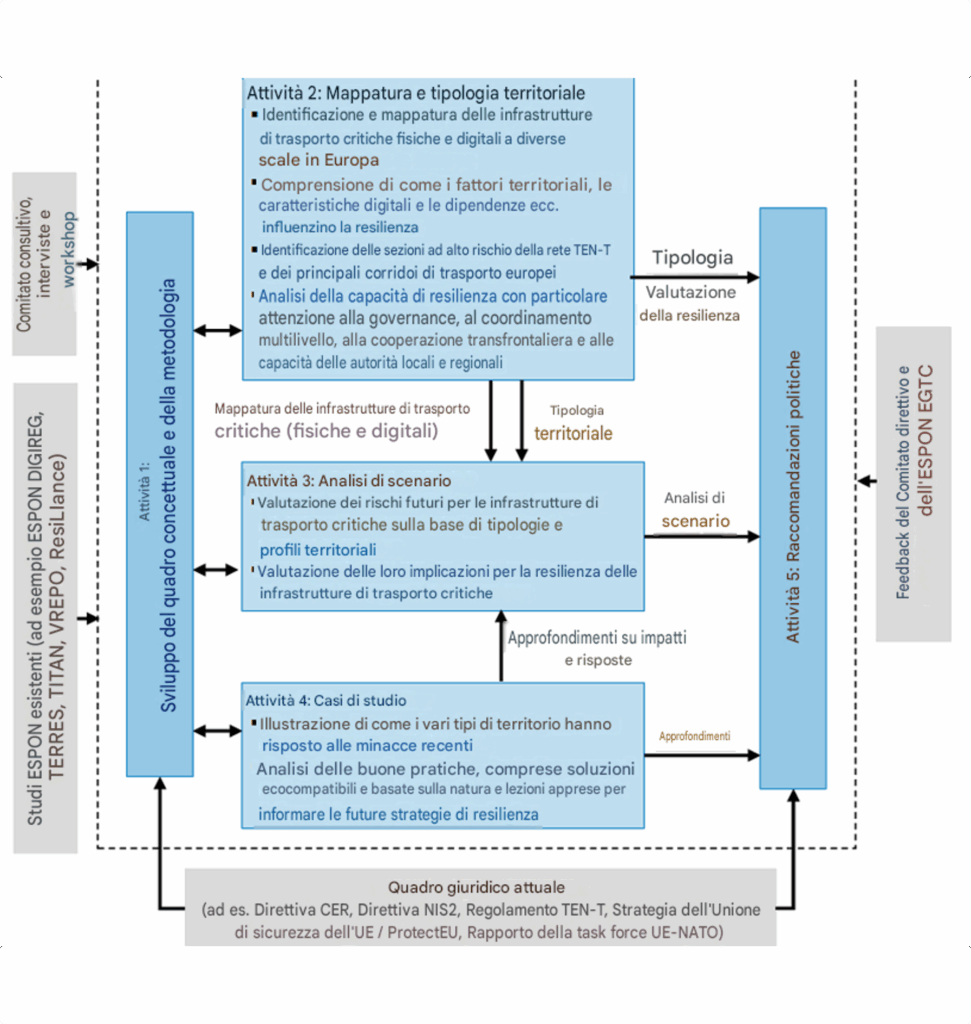
- Territorial outlook on the resilience of critical transport infrastructure across European regions (TRANSITOR) TRANSITOR is a 21-month project funded by European Regional Development Fund (ERDF) (2021/2027) under ESPON 2030 Programme. The objective of the project is to provide evidence-based guidance to policymakers at all geographical levels to enhance the security and resilience of Europe’s critical physical and digital transport infrastructure with a specific focus to consider territorial characteristics. TRT leads Task 2: Mapping & Territorial typology • Mapping physical and digital critical transport infrastructure – TENT elements, data centers, control and traffic management centers, etc. • Analysis of the relevant EU legislation (in particular Directive 2022/362 on the charging of vehicles and Directive 2019/520 on the European Electronic Toll Service); • Developing territorial typology at NUTS3 level – considering infrastructure function (hub, connector, gateway), spatial features (centrality/peripherality), exposure to threats/hazards (natural: floods, heatwaves, wildfires, sea-level rise; technological: cyberattacks, disinformation, and geopolitical) and institutional capacity and resilience • Classification of critical transport infrastructure – development of composite indicators • Deliverable – NUTS3 maps and dataset containing raw and composite indicators TRT will have contributing role in all other tasks, especially in Task 4: Case studies and Task 5: Policy recommendations.
- External support study on the connectivity of major TEN-T airports by long-distance rail Connectivity of major TEN-T airports by long distance trains will bring the EU closer together, advancing the decarbonization of transportation, and enhancing competitiveness and business productivity by reduction in the travel time, increase in the catchment areas, reduction in greenhouse gas emissions and air pollution by providing a viable alternative to travel by air or road and bringing about a modal shift. The overall objective of the study is to provide the European Commission with a robust assessment of the situation of the major EU airports in terms of their connectivity to the TEN-T network by rail long-distance, incl. HSR. The measures needed to enhance the rail usage and the main obstacles will also be identified. Furthermore, the study will analyse the investment gaps and priorities to enable the Commission to draw relevant conclusions in the context of the upcoming MFF, with a focus on the most important actions in terms of effectiveness. The study should also serve as a reference document for national authorities, to inform their investment decisions (best practices). The study will focus on at least 32 European airports: • 20 airports above 12 million passengers averaged over the period 2021 until 2023, • 10 airports below 12 million passengers but recently revealing strong demand growth, • 2 or more newly planned airports (so far in Lisbon and Warsaw new airports have been identified).
- Study on the rationalisation and simplification of EU transport legislation, aiming to reduce administrative burdens and enhance sector competitiveness The project is carried out by a consortium led by Ricardo and including TRT Trasporti e Territorio, TIS – Transportes Inovação e Sistemas, ISL – Institut für Seeverkehrswirtschaft und Logistik, and TEPR – Transport and Environmental Policy Research. This partnership brings together extensive expertise in administrative burden analysis, regulatory simplification, and stakeholder engagement across all transport modes. The study provides the European Commission with a robust evidence base to identify and quantify measures for simplifying and reducing administrative burdens stemming from EU transport legislation. It covers all transport modes (road, rail, inland waterways, maritime, aviation) and follows Better Regulation and REFIT principles, with a strong focus on SMEs. TRT plays a key role in defining and selecting case studies that will illustrate real-life administrative burdens and opportunities for simplification. It also leads the analysis of legislation in the rail and inland waterways sectors, leveraging its expertise to identify critical issues and propose solutions. Furthermore, TRT supports the methodological work for cost quantification and the development of simplification measures, ensuring that recommendations are evidence-based and aligned with the Commission’s objectives.
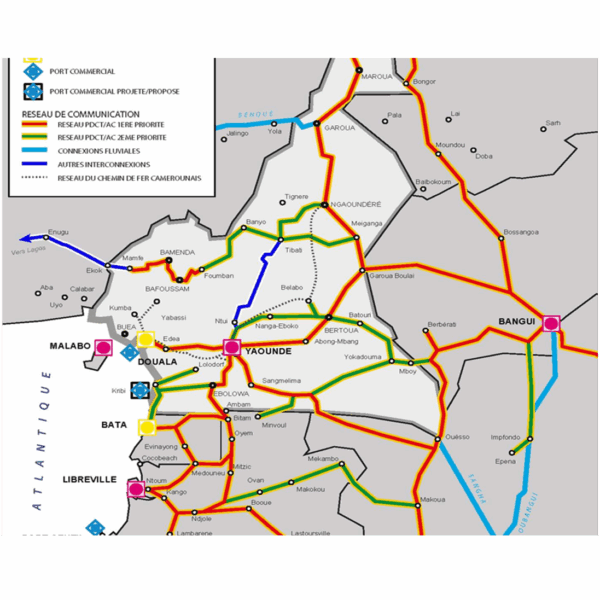
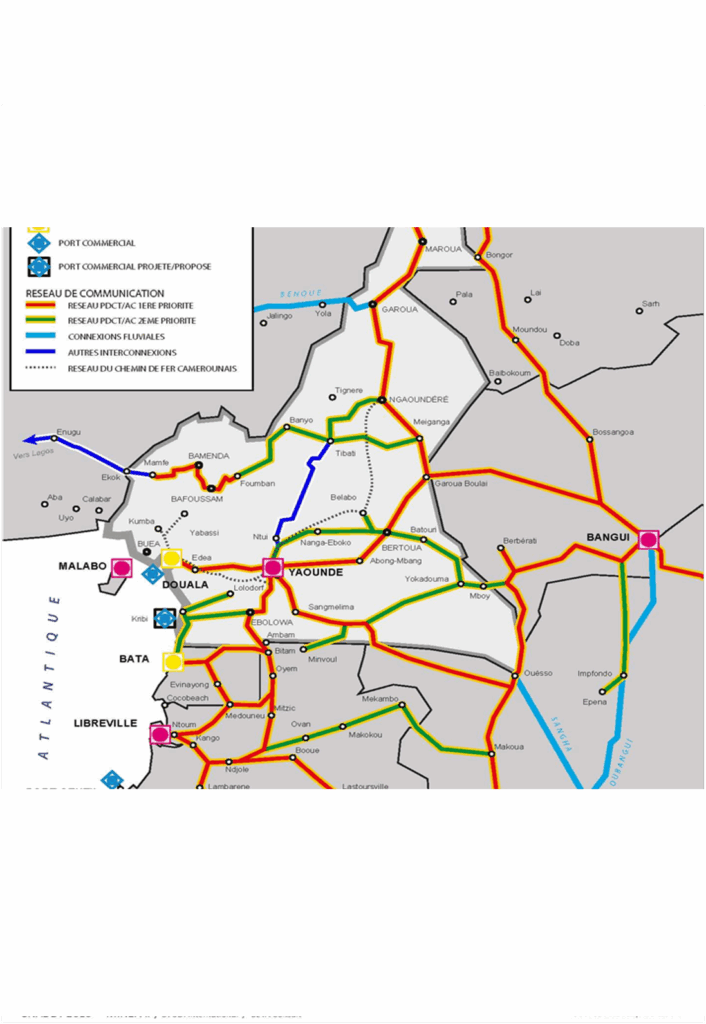
- Development of Cameroon’s National Logistics Strategy and Action Plan for the period 2025-2035 TRT Trasporti e Territorio, with its team of logistics experts, is involved in developing a national logistics strategy for Cameroon and an action plan for the years 2025 to 2035. The activity is divided into two main areas: •Activity 1: develop the strategy and action plan in line with various sectoral development strategies, such as urban mobility plans, regional development plans, river and intermodal transport strategies, etc.. •Activity 2: develop terms of reference for the main priority activities recommended by the national logistics strategy and carry out a feasibility study for the formation of a National Transport and Logistics Coordination Council (CNCTL) in Cameroon. Among the activities listed, TRT is specifically responsible and leader for assessing the infrastructure requirements and logistical services needed, as well as the measures to be taken to improve their performance.
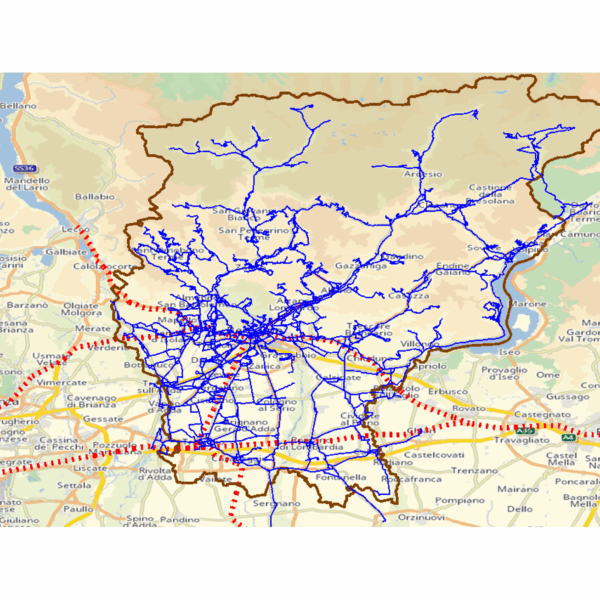
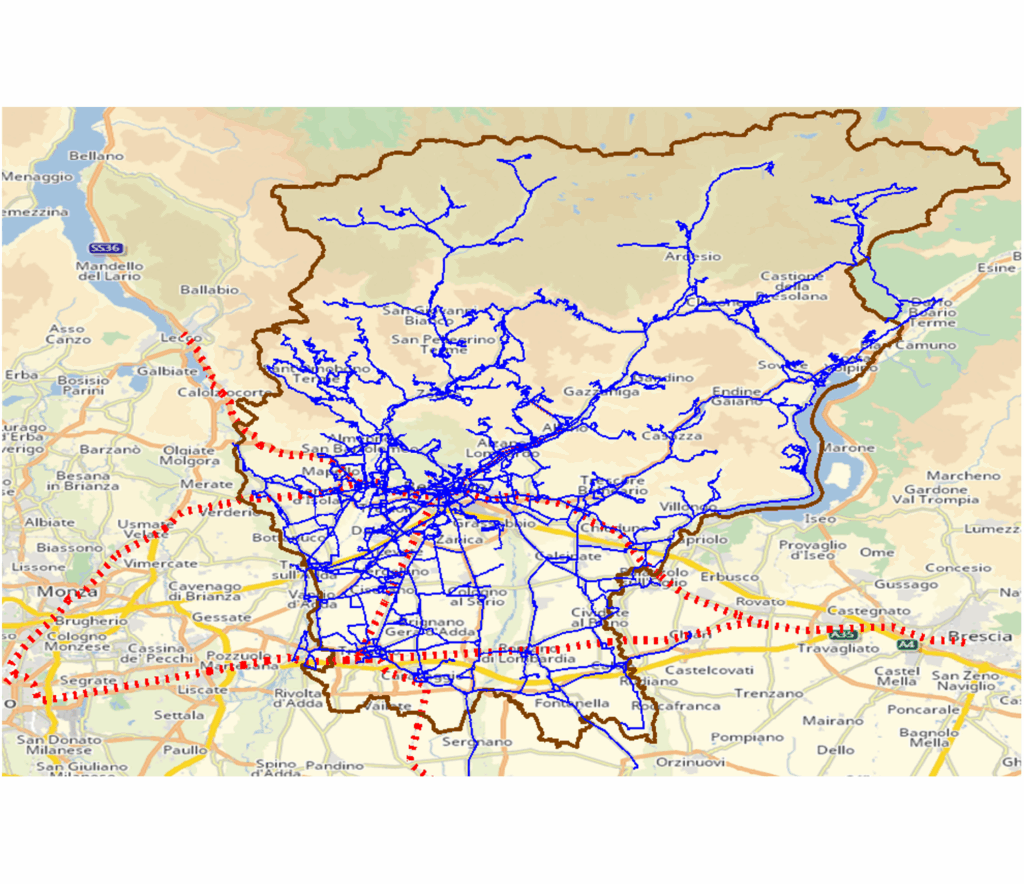
- Development of a transport model to analyse Bergamo students’ travel and analysis of Bergamo functional urban area TRT has been commissioned by the Bergamo Public Transport Agency to conduct two analyses supporting the redefinition of the province’s extra-urban public transport service: •The development of a traffic model with demand assignment for high school students •An analysis of the urban functions of Bergamo’s FUA (Functional Urban Area). The first task has been carried out using the VISUM software, applying an origin-destination matrix of the student population, for which both the municipality of origin and the school destination are known, as well as the GTFS (General Transit Feed Specification) files from various bus operators. To support this part, the information basis has been validated by cross-checking the GTFS timetables with the tabular schedules published by the operators, ensuring the correct reconstruction of service for a typical weekday in winter. Key service indicators were identified, such as bus-km for both the average day and peak-hour periods. Following demand assignment, additional indicators were calculated, including average travel time, boardings and alightings per stop, seat-km offered, and passenger-km or passengers per hour. A complementary analysis considered the comparison between regular weekday service and school-day weekday service. Different scenarios were developed and discussed with the client. The second activity covered by the contract involves drafting a technical-methodological report to assess whether the current delimitation of the capital city’s urban area is appropriate. Various methods and tools used or codified at national and international levels will be analyzed (e.g., the 2001 provincial resolution, the ISTAT methodology based on the OECD-Eurostat approach). For this purpose, origin-destination data from the Lombardy Region was used, along with ISTAT databases and regional and local Open Data. This information was collected in a GIS environment to identify different territorial areas.
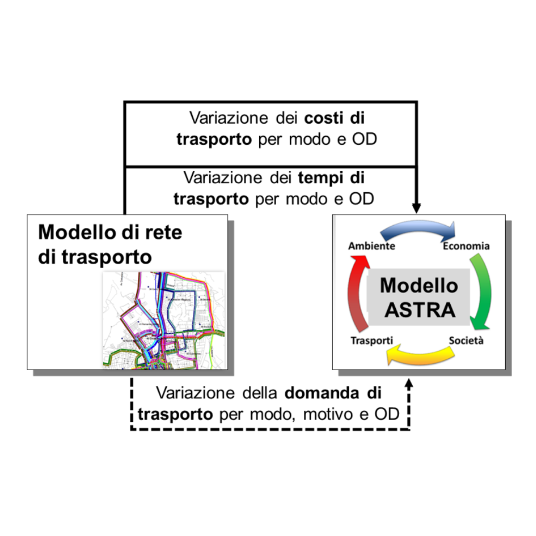
- ASTRA-ЕС model update and improved interaction with multimodal network assignment tools ASTRA is an integrated strategic model employed for policy assessment in the transport and energy field. The model is based on the System Dynamics approach and built in Vensim; it simulates the interaction between the transportation system and the environmental and economy modules. It is developed by TRT and used for several years by the Joint Research Center of the European Commission. TRT supported the use of ASTRA by JRC in two studies: http://www.astra-model.eu/
- Identifying the untapped potential of completing key aspects of the Single European Transport Area (SETA) and of extending it to candidate countries Transport is a central pillar of European integration and a key pre-condition for the European Single Market. Access to seamless and efficient transport services and infrastructure across Europe is key to the functioning of the EU common market, affecting the free movement of people, goods, and services. The objective of the study is to provide a systematic analysis of the existing regulatory and non-regulatory barriers – as well as missing elements – that hamper the creation of the SETA and the completion of the Internal Market for the transport of goods and passengers and understand the economic impact of such barriers and missing elements. The study will use carefully selected case studies, to illustrate, with a combination of quantitative and qualitative analysis: TRT is the project coordinator of a 4-partner (Ricardo, M-FIVE, and TEPR) consortium, responsible for all activities of the studies, and main contact with DG MOVE
- Exploratory study for the new proposal addressing market challenges for the development of Multimodal Digital Mobility Services and the Single Digital Booking And Ticketing Regulation The main objective of the study is to support the development of the European Commission’s proposals for two parallel and complementary regulations: The focus of the study is on medium-long distance passenger trips, above 50 km. The activities will include at first the market analysis on the two aspects covered by the study. On the MDMS demand side, existing and potential demand for the use of MDMS services will be explored, while on the supply side, the presence, practical availability and accessibility of options across the EU will be assessed through the analysis of 100 representative routes. Passenger transport services and online passenger ticketing will be analysed for different modes of transport: air passenger transport (including Norway), rail passenger transport, bus and coach transport and maritime transport. Based on the analysis, the study will also define different policy options and support the assessment of the related impacts through the application of a modelling framework consisting of 6 modules, including the strategic ASTRA model. Impacts on passenger choice and resulting modal shifts will be estimated together with the resulting environmental, economic and social indicators by Member State and in 5 year steps up to 2050. The Consortium is lead by RICARDO, including TRT, TIS and TEPR. TRT contributes to the project as it comes to:
- The National Logistics Strategy for Mozambique was committed to a consortium coordinated by IdeaConsult and involving TRT and EEPLAN (a company located in Mozambique). The main objectives of the assignment are: The assignment will be carried out in four stages according to the following: