- All
- African projects
- assessment
- assessment selected projects
- Assessment selected projects 2
- Assessment selected projects 3
- Assessment selected projects 4
- ASTRA
- Cost Benefit Analysis
- Electric mobility and ITS
- Local Public Transport
- MOMOS
- planning
- planning selected projects
- planning selected projects 2
- planning selected projects 3
- planning selected projects 4
- planning selected projects 5
- projects
- Railways projects
- research
- research selected projects
- research selected projects 2
- research selected projects 3
- studies
- studies selected projects 1
- studies selected projects 2
- studies selected projects 3
- studies selected projects 4
- studies selected projects 5
- TRTingegneria
- TRUST
- urban mobility
- EIT Urban Mobility Impact Assessment The study on “Impact Assessment and Framework” was carried out in 2025 with the purpose of developing an Impact Assessment Framework that includes tools and methodologies to evaluate the impact of EIT Urban Mobility activities at three levels: (i) City and Regional, (ii) Project and Portfolio and (iii) Business Areas. The first part of the work consisted in the assessment of three relevant City Impact Indicators in different EIT UM key city partners. The tool provides detailed guidelines through dedicated templates for the calculation of three City Impacts Indicators: i. Road space reallocation to public space ii. City Club city inhabitants exposed to emissions in urban areas iii. Modal share of sustainable mobility. The second part included the assessment of the social, environmental and economic impacts of Innovation projects for the EIT Urban Mobility Business Plan 2023-2025. The main purpose is to develop a guided process for the fulfilment of the necessary evaluation steps for the evaluation of the projects. The Framework is composed by a Word document, which serves as a guidance, and a user-friendly online interactive tool to guide and support the preparation of a well-structured evaluation of innovative urban mobility projects. A total of 91 projects have been assessed, involving four different calls launched by EIT Urban Mobility (Main Call, SME Call, City RAPTOR Call and Targeted Call) during its 2023-2025 Business Plan. The Framework identified for each project different expected impacts and indicators, to measure the effectiveness of the solutions. The framework included: Lastly, the work enabled the implementation of a Monitoring, Evaluation and Learning (MEL) framework for the assessment of EIT UM’s organizational impacts across all core activity areas of their business areas.
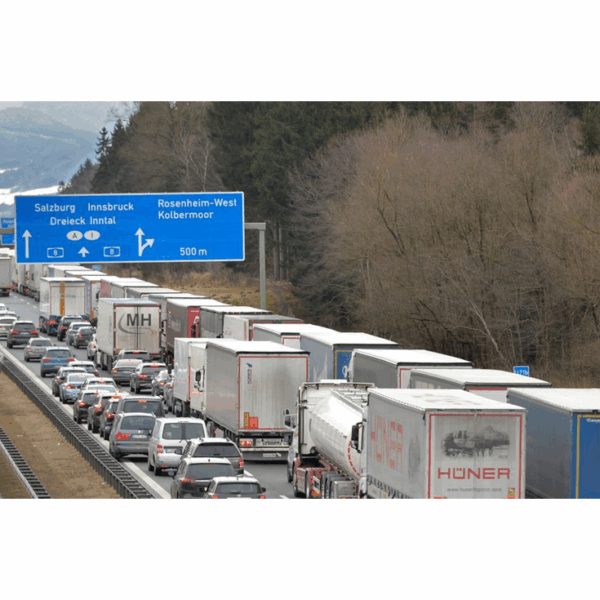
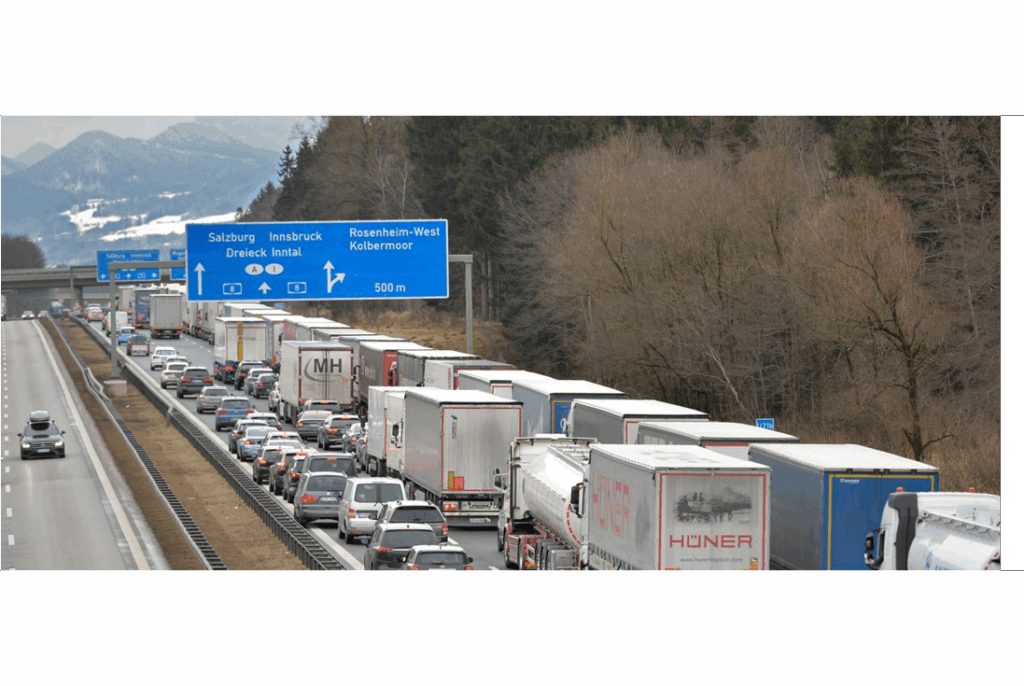
- Technical and legal feasibility study of a variable toll system along the Brenner axis TRT, in collaboration with M-five and supported by a legal team, has been commissioned by the Province of Bolzano to assess the legal and technical feasibility of a variable toll system on freight vehicles along the entire Brenner axis from Munich to Verona, or on individual motorway sections (A22, A13, A12, and A93 The project will carry out: • Analysis of the national legislation applied and applicable in the three countries concerned (AT, DE, IT); • Analysis of the relevant EU legislation (in particular Directive 2022/362 on the charging of vehicles and Directive 2019/520 on the European Electronic Toll Service); • Analysis of the current application by the responsible Authorities in the three countries concerned (AT, DE, IT), any implementation gaps within the scope of the study, and alignment hypotheses; • Analysis of potential legislative obstacles to the application, within the three countries concerned, of a variable toll based on traffic conditions and environmental criteria, alongside a potential digital traffic management system; hypotheses for overcoming obstacles, if any; • Analysis of the various toll technologies currently available to motorway operators in order to identify any necessary technical adjustments or infrastructure required for the introduction of variable tolls according to different possible scenarios; • Conducting interviews with operators and trade associations to estimate the elasticity of demand to tariff changes; • Analysis of the expected impacts resulting from the change in use of the motorway infrastructure during the day or year.
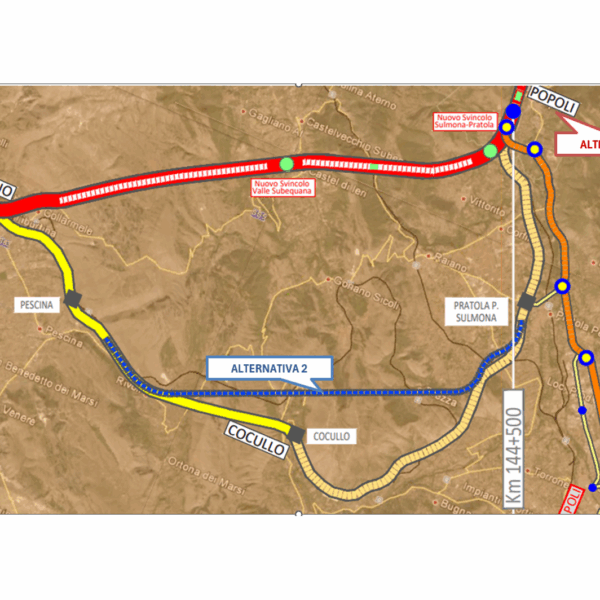
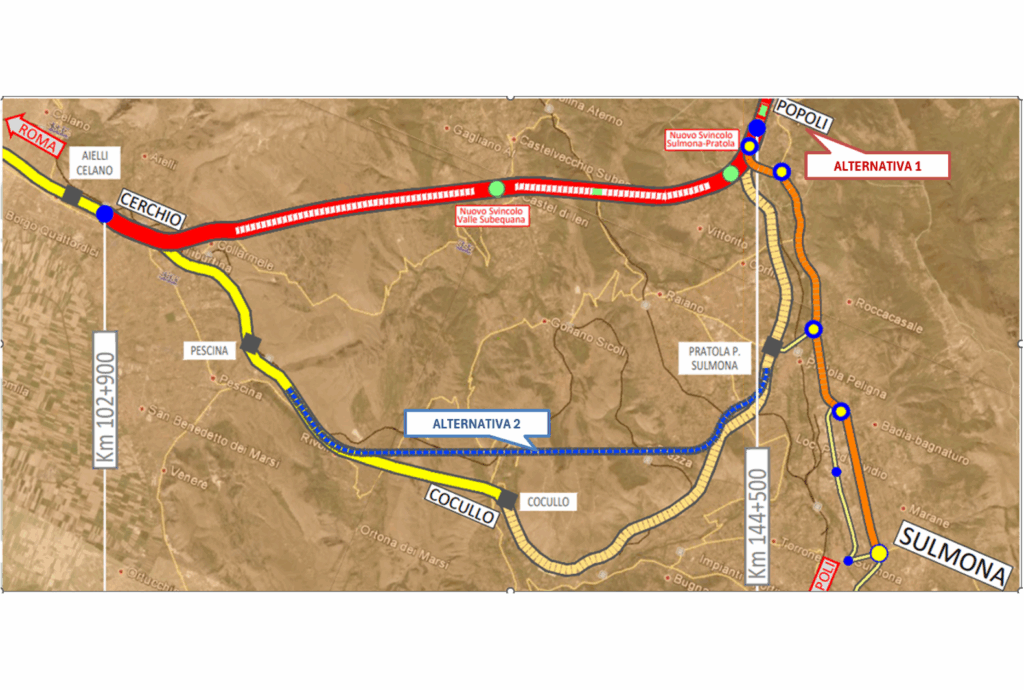
- Comparative analysis of costs and savings of two alternative routes As part of the feasibility study for the structural and functional upgrade of the A25 motorway, with particular attention to the section known as the “Cerchio-Popoli Variant,” TRT was tasked with preparing a comparative analysis of the costs and savings between two possible route alternatives. The currently operational highway section between Cerchio and Popoli presents significant infrastructure challenges related to both the age of the structures and the morphological conditions of the terrain it crosses. In this context, Strada dei Parchi S.p.A. and Italferr have submitted design modification proposals aimed at improving the safety, functionality, and sustainability of the infrastructure. Alternative 1 envisions the construction of three new tunnels, two viaducts, and new junctions, along with the demolition of the existing section between Cucullo, Pratola Peligna, and Sulmona. The new route would extend from the municipality of Cerchio to Popoli and would save approximately 17 km compared to the current situation. Alternative 2 envisions the construction of a new tunnel and the simultaneous demolition of the same existing section between Cucullo, Pratola Peligna, and Sulmona. This solution would save approximately 7.5 km compared to the current situation. For Alternatives 1 and 2, costs and savings were estimated over a 34-year timeframe, including the four years of construction of Alternative 1 (the first to enter into operation) and the 30 years of operation from its opening date. Based on the demand data provided by the traffic study (carried out by Plinomia Srl, and including accidents’ costs estimation as well), three growth scenarios were defined: Precautionary, Optimistic, and Pessimistic. For each scenario, the construction and maintenance costs of the works, the residual value taking into account the useful life of the various components, the time savings, the environmental benefits, and the accident costs of the two alternatives were compared.
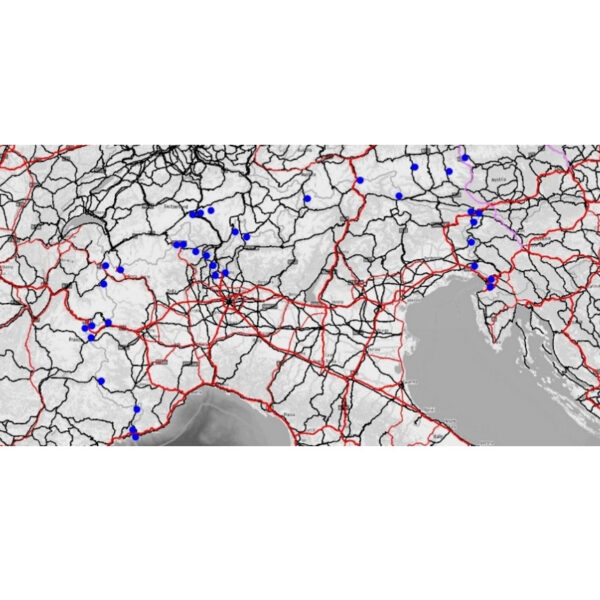
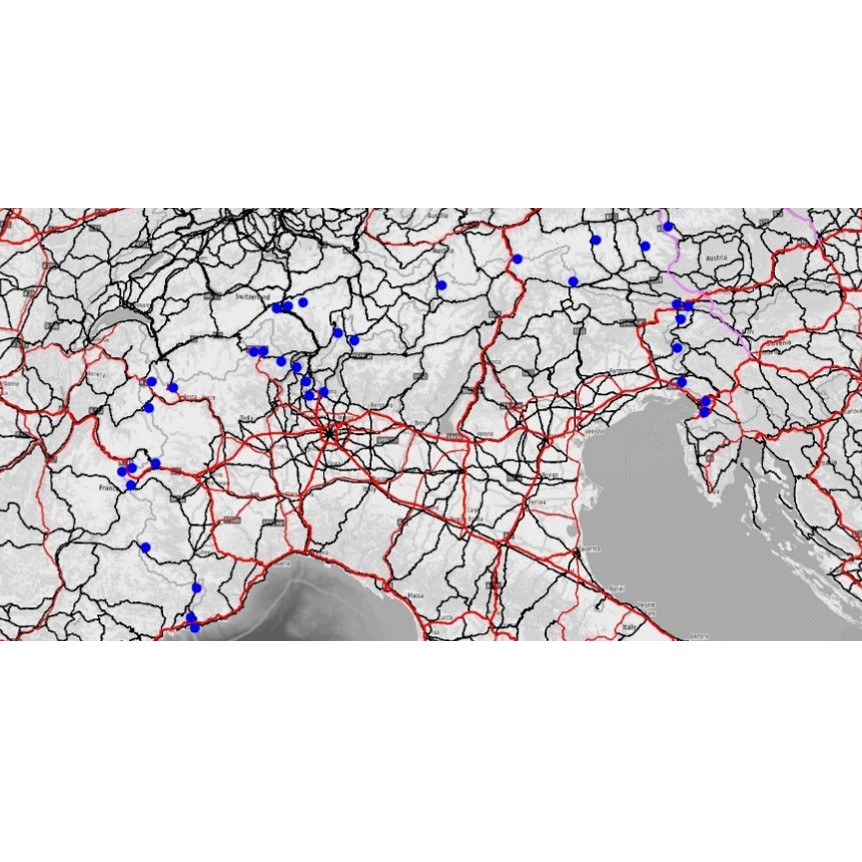
- Application of the TRUST model to support the resilience analysis of the Alpine crossing system The aim of the study was to analyse the resilience of the Alpine crossing system, that is, to evaluate how much the complex of crossings can guarantee an adequate level of service in case of “breakdown” events. For this purpose, the TRUST model, which is a strategic model at European scale, was used to simulate the functioning of the entire range of crossings with respect to the different hypothesized scenarios. The definition of the scenarios considered the fact that, from the point of view of their modelling, it is not the nature of the event that generates a certain variation of the inputs that is significant, but the extent of the variation that is determined in the functioning of the transport system. The scenarios have been translated into variations of one or more input elements of the model itself, namely: availability of some arcs to the modelled vehicle categories, capacity of the road links, travel speed on the links for the modelled vehicle categories. The application of the TRUST model produced, for each scenario, the following results compared to the reference situation:
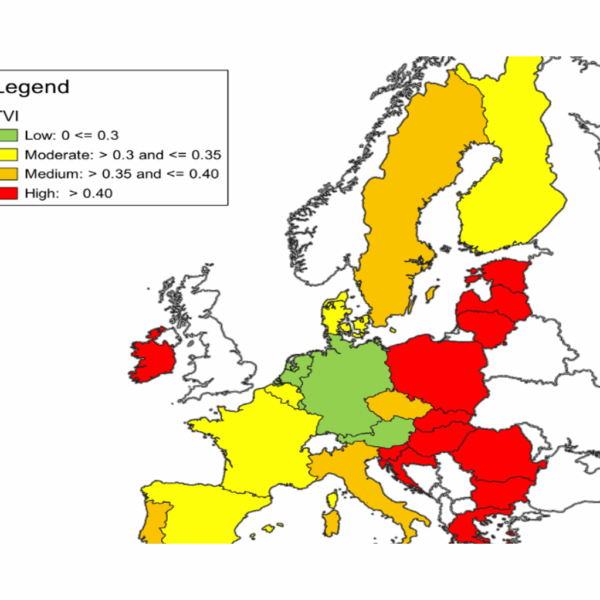
- Assess the degree of the implementation of the ‘user pays’ and the ‘polluter pays’ principles in the transport field in the EU Member States and other developed countries The objective of the study is to assess the extent to which the “user pays” and the “polluter pays” principles are implemented in the transport field. This allows the European Commission to observe the progress of Member States towards the goal of full internalisation of external and infrastructure costs of transport and to identify options for further internalisation. This study is an update of previous studies published in the years 2019 and 2014. The scope of the current study is extended to cover all external costs, all transport modes and, geographically, EU27 plus UK, Norway, Switzerland, Turkey, Western Balkans, Iceland, USA (2 States), Canada (2 provinces), Japan, Australia, New Zealand. Specific objectives concern: Provide estimations of total, average and marginal infrastructure and external costs for all relevant modes/vehicle categories and countries. Provide a detailed and transparent overview of the transport-related taxes and charges, including their structure and revenues, for all relevant modes/vehicle categories and countries. Assess the application for the different transport modes in the relevant countries of both the user-pays and polluter-pays principles. The update of the Handbook on External costs The objectives of the study are achieved through a comprehensive data collection on infrastructure costs (i.e., investment, renewal and operating), transport charges, earmarking of tax revenues and user charges. Appropriate methodologies are applied to estimate external costs for all modes and categories. With regard to the activities of the study, TRT (already involved in previous studies) is responsible for: developing estimates of the external costs related to congestion for all transport modes, developing estimates of infrastructure costs for rail mode and with regard to all categories of external costs elaborating the analysis of six case studies on intermodal freight terminals, and supporting data collection, as country expert for Italy, France, Poland, Latvia and Lithuania. For more information, check our previous study on Sustainable Transport Infrastructure Charging and Internalisation of Transport Externalities
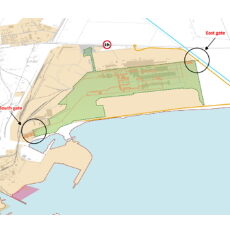
- Analysis of the external logistics of the new metallurgical complex in Piombino The analysis, developed on behalf of Metinvest Adria S.P.A., aimed to assess the impact of the external logistics of the new Piombino steel complex. The logistics operations concern the handling of bulk materials and finished steel products (coils and steel plate packaging) from the production site to the external network and vice versa. These handling operations will involve the railway line from the new complex to the Fiorentina station in Piombino, the junction of the existing railway network, the road network serving the area under study and the port area for relations by sea. The analysis was carried out considering two different delivery options of raw material to the industrial site: Option 1 (Basic), according to which the largest share of the volumes are delivered to the new complex by truck and train; Option 2 (Alternative), according to which 80 per cent of the total quantity is delivered to the site by ship. Furthermore, in the analysis of external transport by rail from the plant to the Fiorentina railway station in Piombino, two different study options were considered, which differ substantially in terms of the route taken to the external network. The current demand for both modes of transport considered was then reconstructed, the demand induced by the production site was estimated, and the infrastructures capacity was verified. As far as logistics between the port and the new complex are concerned, the number of vehicles that can be handled during daily operating hours was identified together with a check on rail capacity for an optimal evaluation of solutions. To supplement the analysis, the study included the dimensioning of checkpoints for vehicle control, loading, weighing and document operations, as well as an estimate of the number of locomotives required to manoeuvre the estimated trains.
- Update of the study on the “Costs and Benefits of the Urban Mobility Transition” The Costs and Benefits of the sustainable urban mobility transition study was carried in 2021 by TRT with the purpose of assessing the impacts of different sustainable urban mobility scenarios in European cities while quantifying the costs and benefits of this transition in 2030 and 2050. The current study consists in an update and improvement of the previous analysis, aiming to: Refine the input data, the intervention levels and targets of the policy measures of the transition scenarios and their timeline of implementation. Improve and enlarge the policy measures applied to the scenarios Run a new modelling simulation to quantify the expected costs and benefits of the sustainable urban mobility transition in European cities by 2030 and by 2050. Draft specific policy recommendations for practitioners. Provide a set of relevant datasets for the development of an interactive tool The calculation is based on an improvement and extension of the MOMOS model, which allows to assess the impacts of different mobility transition scenarios. The quantification of results is applied to 12 city prototypes (representing more than 780 cities in EU27), considering different dimensions (small, medium, and large cities) and geographic areas (southern, central/western, northern, and eastern Europe). The project will consider three potential scenarios, based on a combination of policy measures taken from key EU initiatives and related to the specific emphasis of each scenario. The available measures are of a different nature and comprehensively cover the range of options that cities currently have available to promote the transition to sustainable urban mobility, belonging to eight different policy groups: Shared Mobility; Innovative mobility services; Vehicle fleet & Charging Infrastructure; Transport Infrastructure; Transport avoidance and behaviour; Pricing Schemes; Traffic management and control; urban logistics. The outputs of the study will consist in a series of indicators from three domains, estimated at base year 2022 as well as at future years 2030 and 2050: transport (modal split, car ownership), environment (CO2 and air pollutant emissions, fatalities), and economic (city costs, revenues, user and freight operator costs, and externalities). Also, building on the results for the 12 city prototypes and on a policy effectiveness comparison of the different groups of policy measures, a series of recommendations focused on mobility practitioners will be provided. For more information: Previous contract
- Study on cross-border investment needs and climate adaptation of the TEN-T network The effective implementation of the TEN-T policy, with the completion of the core network and the extended network by 2030 and 2040, is key to creating a competitive industry, expanding the labour market, promoting growth and jobs and improve the daily lives of European citizens. It is therefore important to ensure sufficient investment for the completion of the TEN-T network. While it is important to complete the TEN-T, it is equally important to ensure that the infrastructure resists the threats of extreme events resulting from climate change, which will continue to increase in frequency, intensity, duration and spatial extent in the coming decades. The objectives of this study are: 1) identify the investments necessary to make the TEN-T resilient to climate change, 2) identify the investments necessary to remove the cross-border bottlenecks of the TEN-T and ensure its completion. In the study conducted together with M-FIVE (DE), VUB (BE) and ISL (DE), TRT is responsible for:
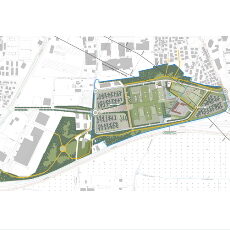
- New hospital in piacenza: transport study and cost-benefit analysis for the design of the feasibility study for the new location in area 5 TRT Trasporti e Territorio was commissioned by the Local Health Unit (AUSL) of Piacenza to provide technical support to the design group led by Policreo Srl, with the in-depth studies on the Transport Study and the Cost-Benefit Analysis developed within the Feasibility Study, (drawn up in accordance with art. 14 of Presidential Decree No. 207/2010), of the New Hospital of Piacenza related to area 5 (AL 9), located in the urban sector within the urban ring road, between Corso Europa and Strada Farnesiana. The study is divided into three main activities: the first is about the mobility and parking system related to the current hospital location, analysing in detail the system of roads, parking and public-private accessibility of the area. the second is about the functionality of the road infrastructures serving the new hospital in Piacenza, assessing the impact of the private mobility system, in terms of road infrastructures and the parking system; the third explores cost-benefit analysis issues, comparing the new project of the hospital with the option of maintaining and upgrading the existing hospital. The cost-benefit analysis estimates the project’s contribution to improving the social-economic well-being of the community, i.e. it estimates whether the social-economic advantages, or benefits, outweigh the disadvantages, or social costs. Related projects: Transport study and cost-benefit analysis of the new hospital in Piacenza