- All
- African projects
- assessment
- assessment selected projects
- Assessment selected projects 2
- Assessment selected projects 3
- Assessment selected projects 4
- ASTRA
- Cost Benefit Analysis
- Electric mobility and ITS
- Local Public Transport
- MOMOS
- planning
- planning selected projects
- planning selected projects 2
- planning selected projects 3
- planning selected projects 4
- planning selected projects 5
- projects
- Railways projects
- research
- research selected projects
- research selected projects 2
- research selected projects 3
- studies
- studies selected projects 1
- studies selected projects 2
- studies selected projects 3
- studies selected projects 4
- studies selected projects 5
- TRTingegneria
- TRUST
- urban mobility
- Drafting of the Biciplan, an strategic vision for cycling mobility in the city of Piacenza as part of wider mobility system introduced by the Sustainable Urban Mobility Plan (SUMP) In 2018 the Municipality of Piacenza started the process of reviewing and updating its mobility planning tools. After having elaborated the Sustainable Urban Mobility Plan and the Urban Traffic Plan, the Municipality has entrusted TRT with the drafting of the new Biciplan, that represents a deepening of the strategic vision for cycling already introduced in the approved SUMP. The Biciplan assigns a primary role to cycling with the aim to satisfy the mobility needs not only related to leisure but also (and especially) to the everyday commuting. The compact urban form of Piacenza with its orographic and climatic conditions plays in favour of a greater diffusion of cycling. Indeed 22% of residents already regularly cycle to work. The drafting of the Biciplan, started in April 2021, consists of the following activities Analysis of the local cycling mobility system and planning context with particular attention to the existing cycling network and related services, as well as the analyses of the cycling demand and road accident rates; definition of the methodology and the objectives for the prioritization of measures, also taking into account the limited resources; elaboration of the Plan proposal through the identification of policies and measures able to define the infrastructure, the services and the communication activities to encourage the use of bicycles as well as other aspects related to urban logistics and last mile deliveries. the quantification of economic resources necessary to implement all actions included in the plan and the definition of the monitoring system including indicators and targets . For more information The biciplan as a sector plan of the SUMP “Sustainable Mobility Planning in Piacenza, Italy”. Case study published by Eltis Platform
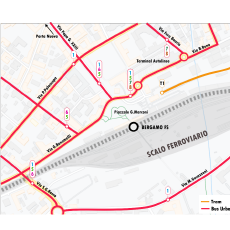
- Preliminary study for the definition of development scenarios for the intermodal hub of the Porta Sud area, near the Bergamo rail station ATB Mobilità SpA assigned to the temporary association of enterprises formed by TRT Trasporti e Territorio and Policreo Società di Progettazione the contract for a study aimed at analysing the prospective structure of terminals, services, and technologies supporting the development of the intermodal hub to be build in Bergamo Porta Sud area, near the railway station. Activities included: A transport analysis, with the aim of obtaining a solid reference framework on the traffic flows (travellers and vehicles) that use and will use the intermodal hub. The evaluation of transport and environmental variables, through the application of a traffic model, allows to outline specific design considerations with the aim of guiding the development scenarios of the area. A review and analysis of international case studies relating to integrated mobility hubs, with the objective of identifying the design criteria to be followed in the design phase of the future intermodal hub in Bergamo. The development of proposals regarding scenarios that may be envisaged in the intermodal hub, with specific reference to connections and movements within the area (i.e., seamless transfers between transport terminals – urban and non-urban buses, tramways, trains, shared mobility facilities, etc.). The design of transport and architectural layouts related to the urban terminal of the existing T1 and the planned T2 tram lines, as well as of the new suburban, regional and long-distance bus terminal.
- Design and technical assistance for the implementation and tendering of a seasonal public transport service in the Municipality of Melendugno (Lecce, Italy) TRT Trasporti e Territorio Srl was commissioned by the Municipality of Melendugno to support the definition of a public transport service to be provided in the summer months connecting all the coastal marinas in its territory (Torre Specchia, San Foca, Roca Vecchia, Torre dell’Orso and Torre Sant’Andrea), as well as between the more inland areas (the town centre and the hamlet of Borgane) and the coast. The activities concerned in particular the revision of the existing daily service based on the “Mare in Bus” and “Terra-Mare in Bus” lines, as well as the preparation of the tender documents for the assignment of the service. The new service was tailored to the needs expressed in previous seasons, which in particular required an increase in the capacity of the vehicles used and faster journey times. The design of the new service included a review and verification of the stops, the inclusion of new stops and the definition of the routes and the operating schedule for both local lines. The timetables were integrated with those of the extra-urban buses connecting Otranto and Lecce. The service was successfully tested during the 2021 tourist season in order to calibrate the final bidding scheme and prepare for the subsequent multi-year tender. TRT also provided indications regarding the area’s overall mobility system, verifying the offer of parking in dedicated parking areas, on-street parking, the provision of pedestrian areas and limited traffic zones and, in particular, the impact on traffic and public transport services of the new coastal cycle/pedestrian path planned by the Municipal Administration. For more information visit visitmelendugno.com
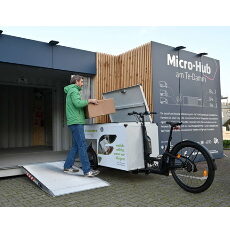
- Feasability study of urban freight transport, sustainable access to Reggio-Emilia historic centre The feasibility study of urban freight transport (UFT) sustainable access to Reggio-Emilia historic centre is a project contracted by Reggio Emilia Municipality. The project is underpinned by the results of the RESOLVE initiative (funded by Horizon 2020) that in the last three years, together with local administration surveys, has monitored average city centre accesses of both retailers and logistic operators. The study aims to understand the feasibility of urban consolidation centres (UCC) or micro consolidation centres (MCC) to favour last-mile sustainable operations throughout cargo bikes. This is gained by gathering a detailed level of information concerning local user necessities via online surveys and focus groups. Also, the analysis intends to evaluate the quality of infrastructure considering its compatibility with cargo bikes needs. Reggio-Emilia cyclelogistics feasibility study partly relies on local retailers and logistic operators who will be invited to join the Cyclelogistics Partnership. The joint venture is meant to define daily operative requirements as well as to form a permanent group of initiative forerunners and users. Such requirements will determine the characteristics of the consolidation centres in terms of dedicated structure (permanent, semi-permanent, temporary) and type of furniture/spaces that must consider the services offered and freights categories. The operative scheme would consist of the intermodal last-mile distribution obtained by the transhipment of parcels from heavier vehicles towards cargo bikes. Such a scheme would prevent or reduce the access of little optimised vehicles as well as polluting, harmful and space-consuming ones in the historic centre. Therefore, offering improved city centre attractivity without harming local supply needs, rather optimizing vehicles according to given spaces and offering more sustainable albeit efficient logistics operations.
- SLOWMOVE – A study on the development of e-mobility in the waterway between Locarno and Milan TRT, together with Ambiente Italia, was entitled by Novara Province to develop a study within the INTERREG project «SLOWMOVE Ponti d’acqua verso il futuro. Lo sviluppo del trasporto lungo il Lago Maggiore, il Ticino ed il sistema dei canali secondo una prospettiva di rispetto ambientale e di incremento del turismo green» (SLOWMOVE Water bridges towards future. Development of the territory along Maggiore lake, Ticino river and canals in a perspective of environmental protection and development of green tourism). The first phase of this study was focusing on supply of charging stations and other electrified modes of transport. Moreover, it provided an overview of the area by linking together demographic data, tourist attractions, tourism statistics, etc. Furthermore, a legislative analysis was included for both Italy and Switzerland, regarding inner water navigation, e-mobility and its charging standards together with an overview of planning documentation. The second phase consisted in the formulation of three different scenarios (high, medium and low) that tried to foresee the development of the charging station infrastructure. Those scenarios were evaluated by local stakeholders with a participative process. Eventually, a third phase included an economical and an environmental impact of the identified scenarios. The first one evaluated the investment cost for every scenario and the demand characteristics. The second compared environmental performances of traditional and electric mobility and it estimated emission reduction. For more information (available only in italian) Press release about Slowmove workshop “La vocazione del territorio di Slowmove per la mobilità sostenibile lungo l’idrovia. L’indotto economico legato alla fruizione turistica e allo sviluppo del settore” (The vocation of the Slowmove area for sustainable mobility along the waterway. The economic impact of tourism and its development) YouTube video of Slowmove workshop “La vocazione del territorio di Slowmove per la mobilità sostenibile lungo l’idrovia. L’indotto economico legato alla fruizione turistica e allo sviluppo del settore” (The vocation of the Slowmove area for sustainable mobility along the waterway. The economic impact of tourism and its development) The report published on Novara Province website The program of the conference “Waterway & Mobility State of the Art, Results and Perspectives” (“Idrovia&Mobilità Stato dell’arte, risultati e prospettive”) and its presentations (in italian) The program of the conference “A lighthouse on the waterway” (“Un faro sull’idrovia” in italian) and the video of the first part of the event, during which TRT presented its cotribution (in italian).
- Sustainable Urban Mobility Plan (SUMP) of Ravenna (Italy) and sectorial mobility plans As a result of a tendering procedure, TRT Trasporti e Territorio, in association with META Mobilità Economia Territorio Ambiente and ITL Istituto sui Trasporti e la Logistica, has been selected by the City of Ravenna to prepare their Sustainable Urban Mobility Plan (SUMP) and the related sectorial mobility plans. Team’s activity is focussed on the preparation of the following documents, among other: Sustainable Urban Mobility Plan, which is articulated in several methodological steps related to: 1) monitoring and assessment of the current SUMP’s results; 2) background analysis of the mobility-related framework and its environmental, social and economic impact in Ravenna; 3) identification of the strategies for the construction of the SUMP scenarios; 4) design of detailed alternative scenarios for the SUMP; 5) evaluation procedure, implementing a ex ante transport model (VISUM). The environmental sustainability of the SUMP is verified through the application of the SEA procedure. Public Transport Plan, coherently developed with the SUMP, which includes a technical and economic feasibility study for the implementation of a low- or zero-emissions public transport system. General Urban Traffic Plan, prepared from objectives, strategies and measures previously defined in the selected short-term scenario of the SUMP. Urban Parking Plan, Functional Classification of the Road Network, Electric Mobility Plan, Road Safety Plan, Cycling Mobility Plan, Strategic document on urban logistics. The drafting of the Plans makes use of innovative methods for the quantification of Ravenna’s transport demand (for example, using data derived from the analysis of the cellular network), which are flanked by more traditional site surveys (vehicle counts, origin-destination surveys, counts on PT lines and at stops, etc.). Finally, all phases are accompanied by a vast communication and participation campaign, which sees the involvement of citizens and stakeholders through public meetings and online questionnaires.
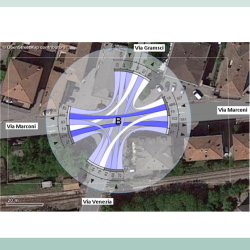
- Application of a microsimulation model to evaluate different hypotheses for the reconfiguration of some road junctions in the municipality of Sorbolo The transport study considers different design alternatives to resolve critical issues concerning the Provincial road 62R in Sorbolo Mezzani, a small municipality in the Province of Parma. The transport study was conducted through the construction and application of a traffic microsimulation model using PTV Vissim software. The aim of the project was to evaluate, in transport terms, the different hypotheses for the reconfiguration of the nodes in the small municipality. The simulations were carried out wit respect to both morning and evening pick hours. The following activities were carried out: Acquisition of demand data and realization of traffic surveys in the concerned intersections; Construction and calibration of a microsimulation model of the current status; Implementation and modelling analysis of design alternatives and evaluation of transport impacts (in terms of average and maximum queue lengths, delay in crossing the node and LoS – Level of Service) identification of the optimal design configuration.
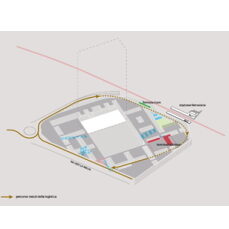
- Design competition for the new business centre of the Sicilian Region In 2019, the Regional Sicilian Government launched a public contest for the design of its new headquarter with the idea of centralizing its different administrative functions and investee companies that are currently distributed in different locations throughout the city. The aim of the intervention is to create a hub that would reduce functional difficulties and ensure greater efficiency in the services provided to citizens and municipal administrations. This would also help cutting unnecessary trips and considerably reduce impacts in traffic and pollution. TRT Ingegneria participated to the contest with the role of mobility expert, together with a wider consortium composed by MJW Structures (Italy), MATE Engineering (Italy) and led by Xaveer De Geyter Architects (Belgium). TRT Ingegneria had the role of organising the public and private mobility system by defining the circulation scheme, the parking system, and the intramodality with the “Ugo La Malfa” railway station of the Palermo bypass. The proposal ranked among the top five over 30 participants during the first phase of the public contest, thus gaining access to the second phase of the competition.
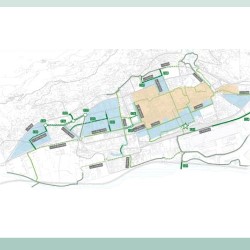
- Update of the General Urban Traffic Plan (PGTU) of Aosta The study concerned the update of the Aosta General Urban Traffic Plan (PGTU) already prepared by TRT Trasporti e Territorio about 10 years ago as part of the Metis Consortium. The city of Aosta (about 35,000 inhabitants) concentrates one fourth of the Aosta Valley regional population and plays an important role in regional mobility thanks to its services and economic activities. The activity was launched in November 2019 and it consisted of the following activities: the update of the key mobility factors – demographic and socio-economic structure, transport networks and services supply, mobility demand, environmental and social impacts; the analysis of the on-going planning tools, including an assessment of the state of implementation of the measures included in the previous PGTU (2011); the identification of the urban mobility system’s strengths and weaknesses in order to define the set of strategies and interventions to be included in the new PGTU; the design of the Reference and the Planning scenarios with measures related to: road network and its regulation, public transport system, cycling network, parking system, mobility management, electric mobility, urban logistics and ITS systems; the definition of detailed interventions for specific locations – the Arch of Augustus area, the new university complex area, the railway station area – both from urban planning and from mobility system points of view. The PGTU was approved by the Municipality Council on February 23rd, 2022, with official act no. 23.