- ASSIST – ASsessing the Social and economic Impacts of past and future Sustainable Transport policy in Europe The main objective of the ASSIST project (ASSessing the Social and economic Impacts of past and future Sustainable Transport policy in Europe) was to provide the EU with sound policy advice on the possible social and economic impacts of future sustainable transport policies that would contribute to the strategic objectives of the EU given by the Lisbon Strategy, the Sustainable Development Strategy and the EU-2020 strategy. The role of TRT concerned the modelling line, as leader of the development of the new tool in cooperation with the project leader Fraunhofer-ISI (Germany). Other partners are NEA (The Netherlands), ProgTrans (Switzerland), FŐMTERV (Hungary), CNRS-LET (France).
- Wide-area bicycle plan for the Northern part of the Milano province (Italy) The Municipality of Legnano leader of a group of 23 municipalities in the northern area of Milano, jointly with CARIPLO (Bank Foundation), selected TRT for the preparation of the cycling mobility plan for the North-Milano suburban area. Design of cycling network; Public transport and cycling connections; Cycling services for commuters and leisure users.
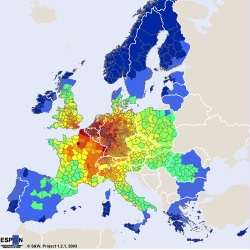
- The ESPON project TRACC (TRansport ACCessibility at regional/local scale and patterns in Europe) The ESPON project TRACC (TRansport ACCessibility at regional/local scale and patterns in Europe) aimed at updating the results of previous studies, extending the range and the spatial resolution of accessibility indicators in response to the most recent policy questions. The TRACC conceptual framework is based on a systematic and comprehensive theoretical consideration of the major dimensions of accessibility, as well as of the most frequently used types of accessibility indicators and extensions of these. TRACC developed a systematic and consistent set of accessibility indicators, differentiated according to three spatial contexts (global, European, regional) and also between travel and freight. At European level, accessibility indicators for travel are further distinguished between traditional and newer ones. At regional level, moreover, a new set of indicators is included focusing on the accessibility to services of general interest, which are among the top priorities in the current policy agenda.
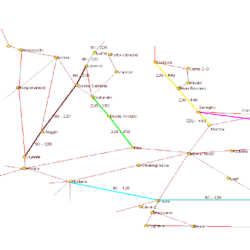
- Parma Urban Mobility Plan TRT was responsible for updating of the Parma Urban Mobility Plan (also previously prepared by TRT in 2005 and adopted in 2006). The plan was an innovative tool as sustainability goals gave emphasis to a concept of mobility that introduced different measures and policies for different parts of the city: central area, the city of pedestrians and soft mobility;ù urban area, the city of the space shared between the soft mobility and the vehicular mobility; wide area, the city’s private and collective mobility
- Transport Assessment for the introduction of the Multi Lane Free Flow Toll System Project provided a detailed study on the electronic toll systems “free flow” implemented on several international highways and a description of benefits arising from the introduction of the toll system for the new highway Brebemi (Brescia-Bergamo-Milano). The analysis focused on: technological, operating characteristics, different control practices for non-payments and the legal aspects governing the motorway sector. The role and the power of the motorway concessionaire in reducing toll violations has been outlined.
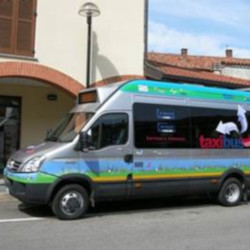
- Dial-a-ride – Analysis of innovative services and software evaluation SAD Trasporto Pubblico Locale SpA commissioned TRT to conduct a benchmark analysis on the dial-a-ride services provided in Italy and Europe. The project had two major objectives: identify within the national context, the dial-a-ride service schemes potentially applicable to the Bassa Atesina area, in terms of territorial extension, population served and local morphology; supply the contractor with an evaluation tool of the software used in other applications, finalised to programme and manage dial-a-ride services.
- “Mediana” motorway TRT was commissioned by the Verona Province to carry out a technical-economic analysis on the provincial road “Mediana”, as a strategic axis connecting Verona to the southern area of the province. TRT estimated the current and the forecast traffic demand on the new road. TRT also contributed to develop the Financial Plan of the new infrastructure. TRT took into account the project financing process in order to give an overview of the financial state of the promoting company during the realisation and operational phases.
- Preparation of tender documents for the provision of Public Transport Services of the Molise Region (technical assistance) ATM Molise involved TRT in the support for the preparation of the technical offer of the tender for the provision of local (extra-urban) public transport services announced by the Molise Region. The technical assistance focussed on the verification and validation of the minimum services programme, the definition of the optimised services (technical proposal), the estimation of quantitative indicators needed to evaluate the proposal and the preparation of draft of the technical documents, as part of Envelop B (Technical Offer).
- Urban and extra-urban services in the area surrounding Piacenza: survey on the transport demand TRT has been commissioned by Tempi Agenzia SpA to conduct a survey on the transport demand of urban and extra-urban services of the province of Piacenza. The study focussed on: design of the survey on the transport demand (get on/off of users, tickets, frequency of use, change with extra-urban transport and train services); preparation shift changes and instructions of the survey’s staff; Collection and elaboration of data. The data collected during the survey allowed to obtain a database on: users getting on/off per stop and line, origin and destination of the passengers and use of tickets and season tickets
- Logistics Between Southern Italy and China The Ministry of Economic Development – Department for Development Policies has commissioned a study to TRT to: identify market factors that may promote the Southern Italy as a logistics platform for the traffic generated from the Italian, European and Mediterranean market to the Far East. The aim of the study was to identify and prioritise investments and measures to boost the international exchanges of goods and the demand for logistics in the South of Italy. Two were the main objectives of the study: to point out the key factors which could support the development of Southern Italy as logistics platform for the exchanges with East Asia; to show the economics and territorial advantages coming from the logistics growth, in particular for the employment and the productivity. The analysis undertaken highlighted the economic benefits arising from the development of the territory logistics, with special reference to employment and productivity. The priority systems on which to focus were three. Gioia Tauro transhipment port, that offers great potential to local economy; Campania logistics system, with Salerno and Napoli ports and the logistics platforms of Nola and Marcianise; Taranto port, with the significant development recorded thanks to big shipping lines. The projects reviewed included the enlargement of the terminal container and the building up of an inland logistics platform.
- Eastern bypass of Brescia The study analysed different options of the alignment of a link with features of a motorway, in the eastern territory of Brescia. TRT coordinated the whole project. Notably, TRT developed the traffic simulation model in reference solution and project scenarios and carried out both cost-benefit and financial analyses.
- Company transport plan of Italcementi TRT has been charged by Italcementi SpA to set the job-home transfers plan for the 900 employees of the three offices placed in Bergamo (IT). The objectives of the plan are: to reduce the need of parking area available for Italcementi employees; to optimize car use for job-home transfers, through the promotion of the car pooling system; to favour the access to the offices, making the bicycle paths and pedestrian crossings safe.
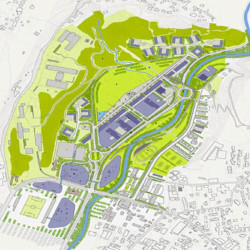
- NQC Masterplan – New Cornaredo District After an international competition (first place), TRT was commissioned to design the mobility aspects of the new Cornaredo district entrance in Lugano (Switzerland) and evaluate the road traffic generated by the planned land use. The project was composed of 3 main phases: The contest (won) (2005); The Master Plan (2006); The Town Planning Scheme (2007). During the various stages, TRT activities concerned: the definition and functional assessment of connection between local and the main urban road system; the definition functional assessment of local road system for district’s traffic distribution. Definition of cycling and pedestrian paths to connect the new district and the green areas; Definition, measuring and management of parking lots and parking facilities at the end-station of public transports (Park&Ride); The translation of planning choices in regulations in the Traffic Plan, by means of a Mobility Index, i.e. the maximum number of peak hour trips allowable per unit of building area.
- Economic analysis of investments in rail nodes – The case study of the node of Milan The study was commissioned to develop and apply a simplified methodology for the economic analysis of major rail infrastructure projects, when to improving rail nodes. The methodology conceived focussed on the trade off between investment cost savings of network capacity and social costs generated by the road traffic diverted due to the missing capacity (in terms of congestion and environmental effects). The methodology and evaluation procedures were tested to appraise several scenarios of interventions, within the rail node of Milan and including the adjacent regional rail network.