24 October 2022

Challenges for urban transport policy after the Covid-19 pandemic: Main findings from a survey in 20 European cities

A paper co-authored by TRT was published online by Transport Policy. The article is based on the outcome of an extensive survey managed by TRT on behalf of the JRC Sevilla of the European Commission in 20 cities across 11 European countries during the second quarter of 2021, with a total of 10000 respondents. The survey explored the changes in transport and mobility patterns that were triggered by the Covid-19 pandemic, as well as citizens’ potential new expectations arising from this situation regarding public transport policy and urban planning. The information collected covered the change in the frequency of technology-based alternatives to travel -such as teleworking and online shopping-compared to the pre-pandemic period. It also included the change in trip frequency, purpose, mode and destination. Using the survey dataset as input, a classification model was applied to explain the change in mode choice based on the respondent characteristics and preferences. Findings suggest that the changes in mobility patterns induced by the pandemic are the result of the combination of the degree of mobility restrictions imposed in each city, the adoption of new lifestyle and work patterns, and individual choices that depend on personal risk aversion.
21 September 2022

SUMP Topic Guide on Planning for Attractive Public Transport

We are pleased to announce today’s publication of the new SUMP Topic Guide on Planning for Attractive Public Transport, for which TRT is the main author. Public transport should be regarded as a challenge to be made more attractive and resilient, through the design of Sustainable Urban Mobility Plans (SUMPs). Urban planners need to go beyond “business as usual” to achieve a tangible modal shift away from private vehicles, towards public transportation. This is a necessary step in the fight to reducing emissions and tackling global warming. To support urban planners and transport practitioners in this process, this SUMP Topic Guide has been developed by the second Policy Support Group of the CIVITAS ELEVATE Coordination and Support Action, with the involvement of five experts from selected organisations (International Association of Public Transport – UITP, European Passengers Federation – EPF, Technical University of Berlin – TUB, City of Gdynia, Gothenburg Transport Operator), the chair of the CIVITAS Policy Advisory Committee, TRT and 12 stakeholders from the urban mobility sector. It provides guidance on public transport in the mobility planning and implementation process, in order to achieve more attractive public transport. The Topic Guide is part of a compendium of EU guidance documents, complementing the revised second edition of the SUMP Guidelines. Read the publication here. This and other SUMP Topic Guides can be accessed via the Eltis website here.  
31 May 2022

The Rail Baltica transport demand model project is now completed

Rail Baltica is a rail transport infrastructure project that integrates the Baltic States in the European rail network connecting Poland, Lithuania, Latvia, Estonia and indirectly also Finland. It is a fully interoperable railway line of more than 870 km in length designed for both passenger and freight transport and planned to become operational in 2027. The Rail Baltica transport demand model project, led by TRT, has developed and implemented a multimodal transport model to forecast the passenger and freight demand for the Rail Baltica infrastructure up to the year 2056.
15 December 2021

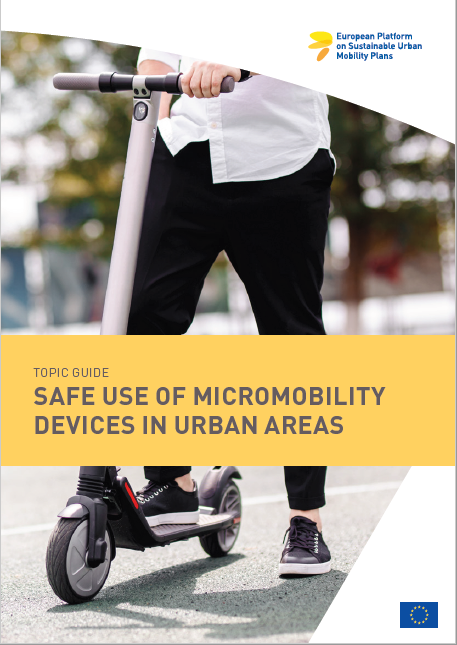
SUMP Topic guide on safe use of micromobility devices in urban areas

TRT is happy to announce today’s publication of the new SUMP Topic Guide on the safe use of micromobility devices, for which TRT is the main author. The SUMP (Sustainable Urban Mobility Plans) Topic Guide has been published alongside the new Urban Mobility Framework of the European Commission. It is the key result from the first Policy Support Group (PSG) of the CIVITAS ELEVATE Coordination and Support Action, with TRT as lead and contributions from 5 experts from selected organisations (TRL, ETSC, POLIS, the City of Paris and the City of Helsinki), the chair of the CIVITAS Policy Advisory Committee (City of Antwerp), BUAS (Breda University of Applied Sciences) and three observers from the cycling and e-sooters sectors. TRT put its extensive experience of the sector into this new Topic Guide and provided new insights into dealing with one of today’s challenging mobility trend. The Topic Guide focuses on micromobility in the SUMP planning and implementation process and is part of a compendium of EU guidance documents, complementing the revised second edition of the SUMP Guidelines. The Topic Guide proposes best practice and key recommendations on the integration of micromobility in urban mobility planning, with the goal to support cities in achieving a safer use of micromobility devices in urban areas. It also supports the European Commission in delivering Action 22 of the Sustainable and Smart Mobility Strategy. It focuses on shared electrically powered personal mobility devices such as e-scooters and provides some guidance on how the users of these vehicles interact with the users of bicycles and electric power assisted cycles (EPACs), as well as pedestrians and other road users.
11 November 2021

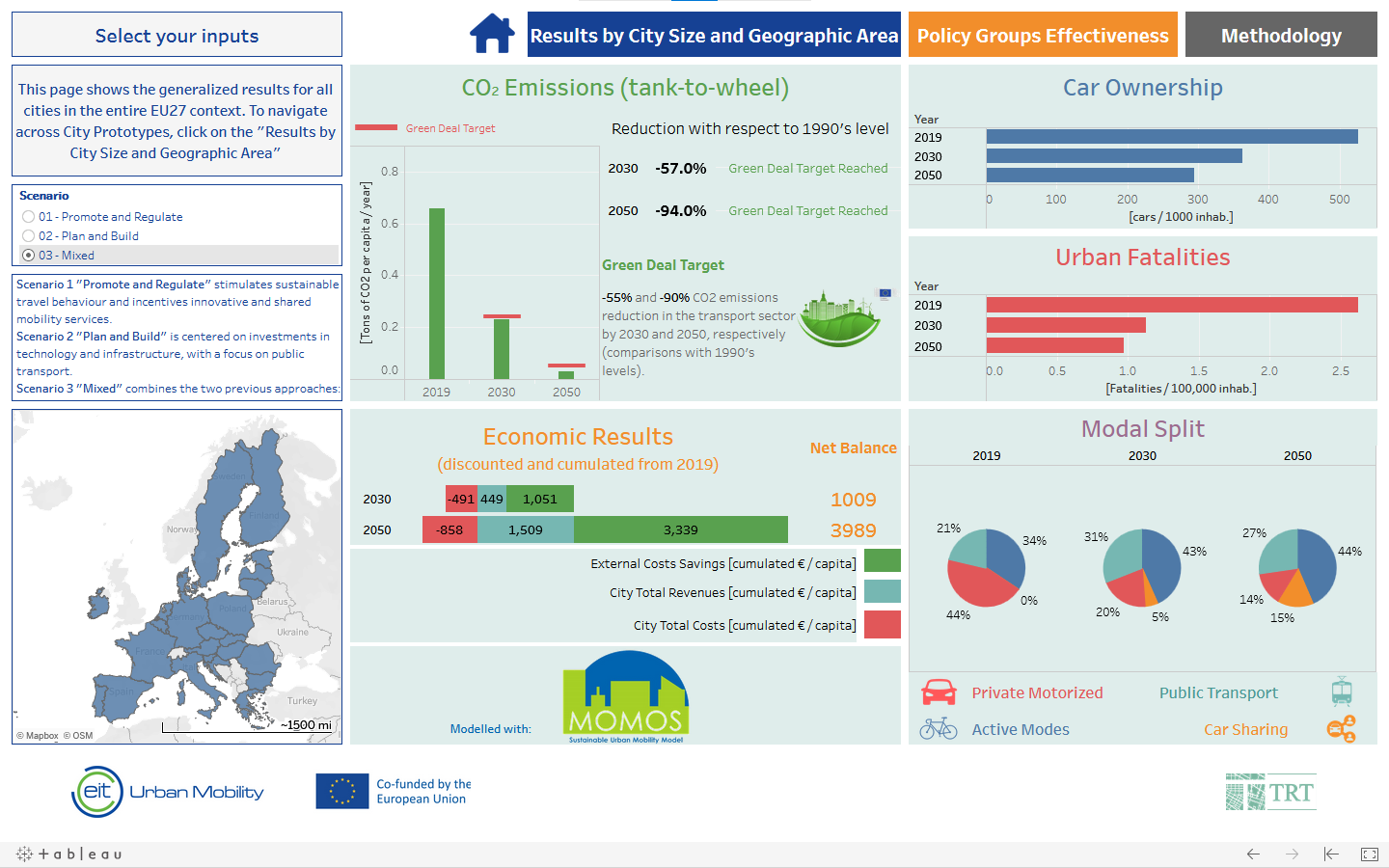
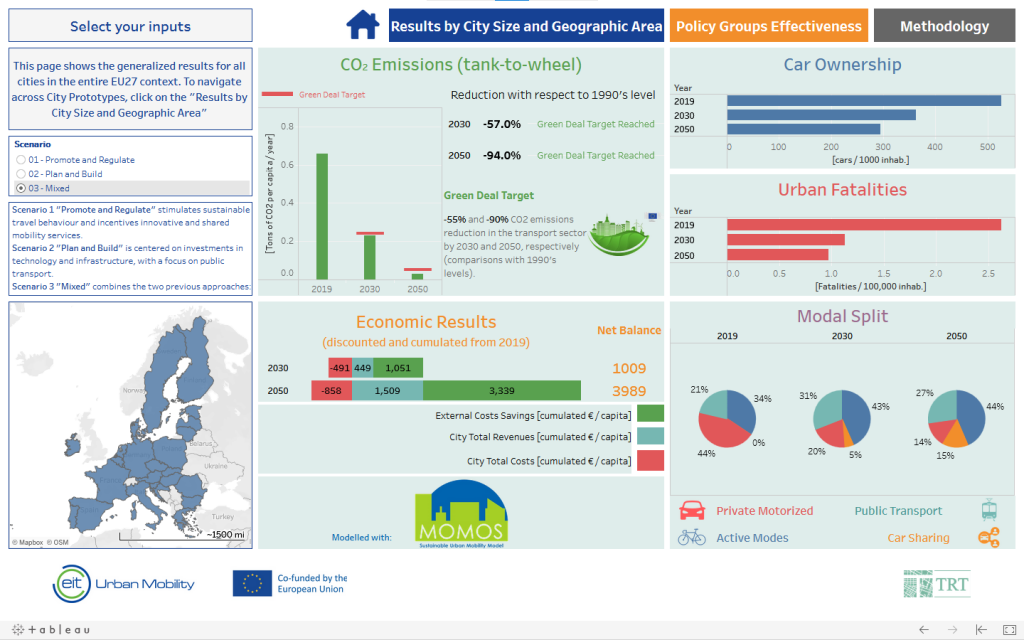
Our study on Costs and Benefits of the Sustainable Urban Mobility Transition is online

How much will the transition to sustainable urban mobility cost in European cities? Which benefits and changes in mobility will it bring? What will be the most cost-effective policies to accelerate this transition? These are some of the questions that a new study from TRT Trasporti e Territorio has been replying to. The study, commissioned by EIT Urban Mobility and released today, produced a quantification of the costs and benefits of the transition to sustainable urban mobility in European cities by 2030 and 2050. The analysis was carried out with the modelling tool MOMOS, which allowed to assess the impacts of different mobility transition scenarios.
7 October 2021

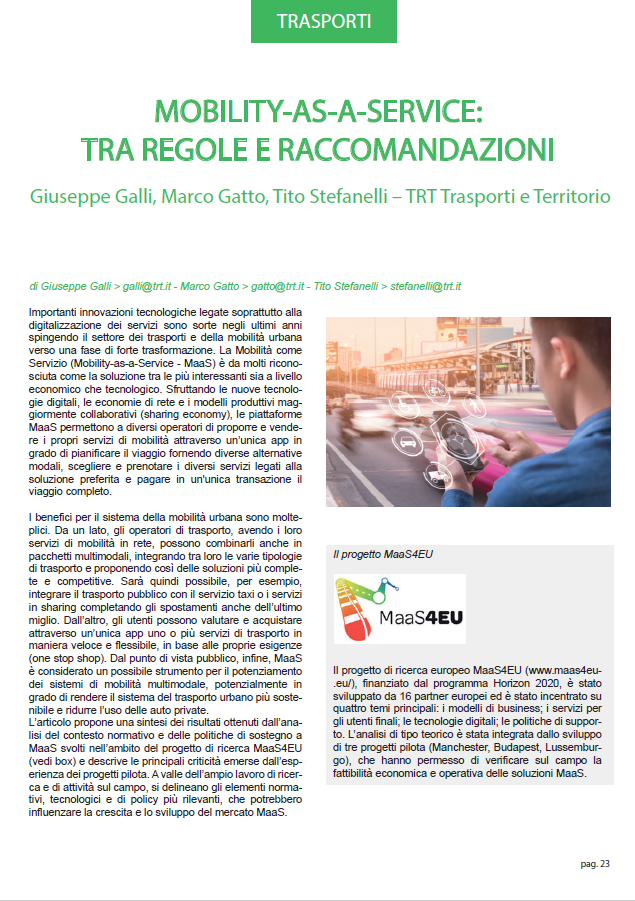
An analysis of the regulatory and policy framework to support MaaS, in the new issue of Smart City and Mobility Lab

The article “Mobility-as-a-Service: regulations and recommendations” has been published in the MMYY edition of Smart City and Mobility Lab. Based on the extensive research activity and the experiences from three pilot projects (Manchester, Budapest, Luxembourg) developed within the research project MaaS4EU, the article discusses the regulatory, technological and policy elements that are key for the growth and development of the MaaS market. Read here (only in italian).
1 September 2021

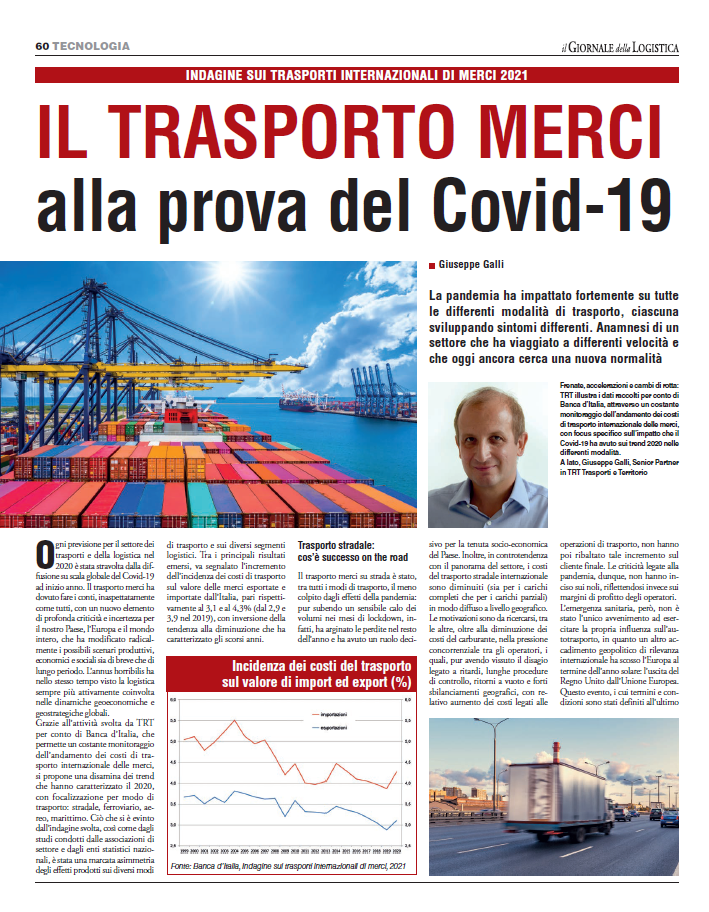
The costs of freight transport during the Covid-19 pandemic

An article on freight transport during the Covid-19 pandemic was published in the July/August 2021 issue of Il Giornale della Logistica. Starting from the activity carried out by TRT on behalf of the Bank of Italy, which involves a constant monitoring of the costs of international freight transport to/from Italy, the article proposes an analysis of the trends that characterized 2020 with a focus on different transport modes: road, rail, air, sea. Read here (only in italian).        
27 August 2021

Global knowledge exchange online event on E-buses: from pilots to mainstreaming

TRT is organising a Global knowledge exchange online event on 16 and 17 September, a cooperation between the World Bank Group and the CIVITAS initiative. E-mobility stakeholders from Latin America and Europe will come together to share perspectives and discuss policy pathways for the deployment of e-buses in urban public transport fleets.   Have a look to the programme and register for the event following this LINK!! The event will be organised in English, Spanish and Portuguese.  
23 June 2021

Survey on International Merchandise Transport – 2020

This paper presents the results of the survey on international freight transport carried by TRT for Bank of Italy (the central bank of Italy) in 2020, as part of the compilation of the national balance of payments. Based on the sample surveys carried by TRT since 1998, the paper describes the key costs trends in the Italian freight transport sector. In 2020 TRT interviewed about 210 international freight operators from different transport segments and collected data on over 6.200 shipments, namely on freight rates and ancillary costs between different origins and destinations. s part of the compilation of the national balance of payments. For the statistics of the balance of payments, moreover, TRT estimates the market shares of freight carriers by nationality. During 2020, the incidence of transport costs on the value of goods exported to and imported from Italy increased, reversing the downward trend observed in the previous years. The transport sector has been inevitably affected by the Covid-19 emergency. The air transport sector suffered most due to a drop in passenger flights, leading to a severe shortage of “belly” capacity and a sharp increase in freight rates. In the maritime sector, significant price increases were observed in the container, ro-ro and liquid bulk sectors. As for land transport, transport costs slightly increased in the rail sector and slightly decreased in the road sector. Link to the project page. Download the full report (only available in Italian)