Davide Tessarollo

21 January 2021

Re-Thinking mobility poverty

The recently-terminated HiReach project has just published a book entitled “Re-thinking Mobility Poverty. Understanding User´s Geographies, Backgrounds and Aptitudes”. TRT, the HiReach coordinator, directly contributed of the writing several chapters. IThe book, which is based on the analytical phase of project, seeks to better conceptualise and define mobility poverty, addressing both its geographies and socio-economic landscapes. It examines the social construction of mobility poverty by delving into mobility patterns and needs as they are differently experienced by social groups in different geographical situations and also offers a comparison of the global phenomenon through fieldwork conducted in the six different HiReach study regions.
13 January 2021

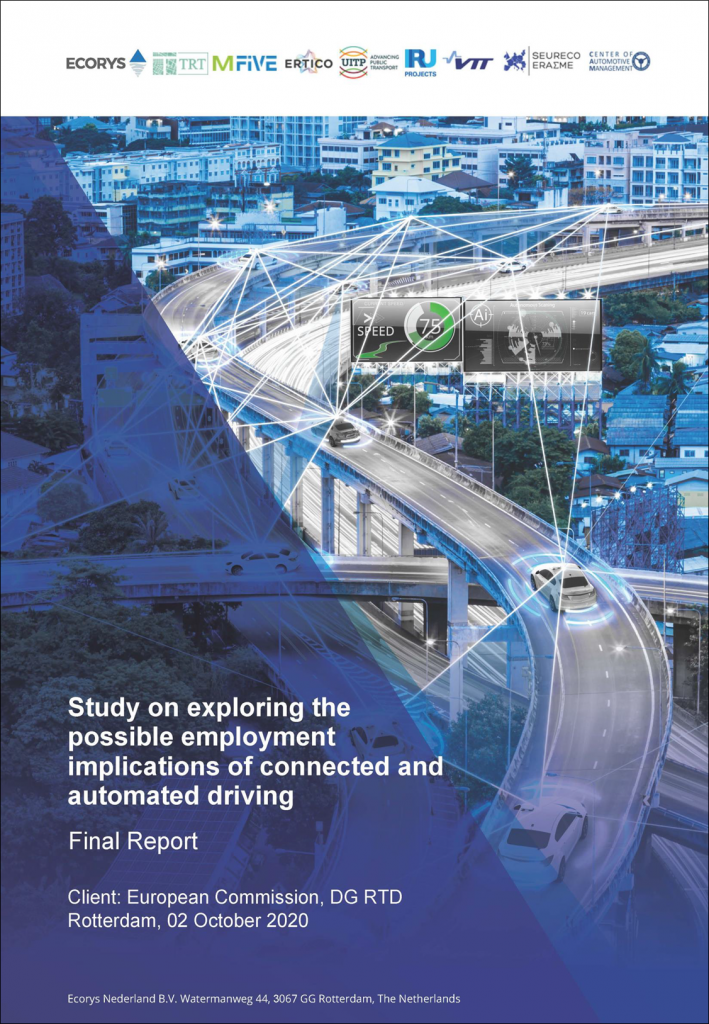
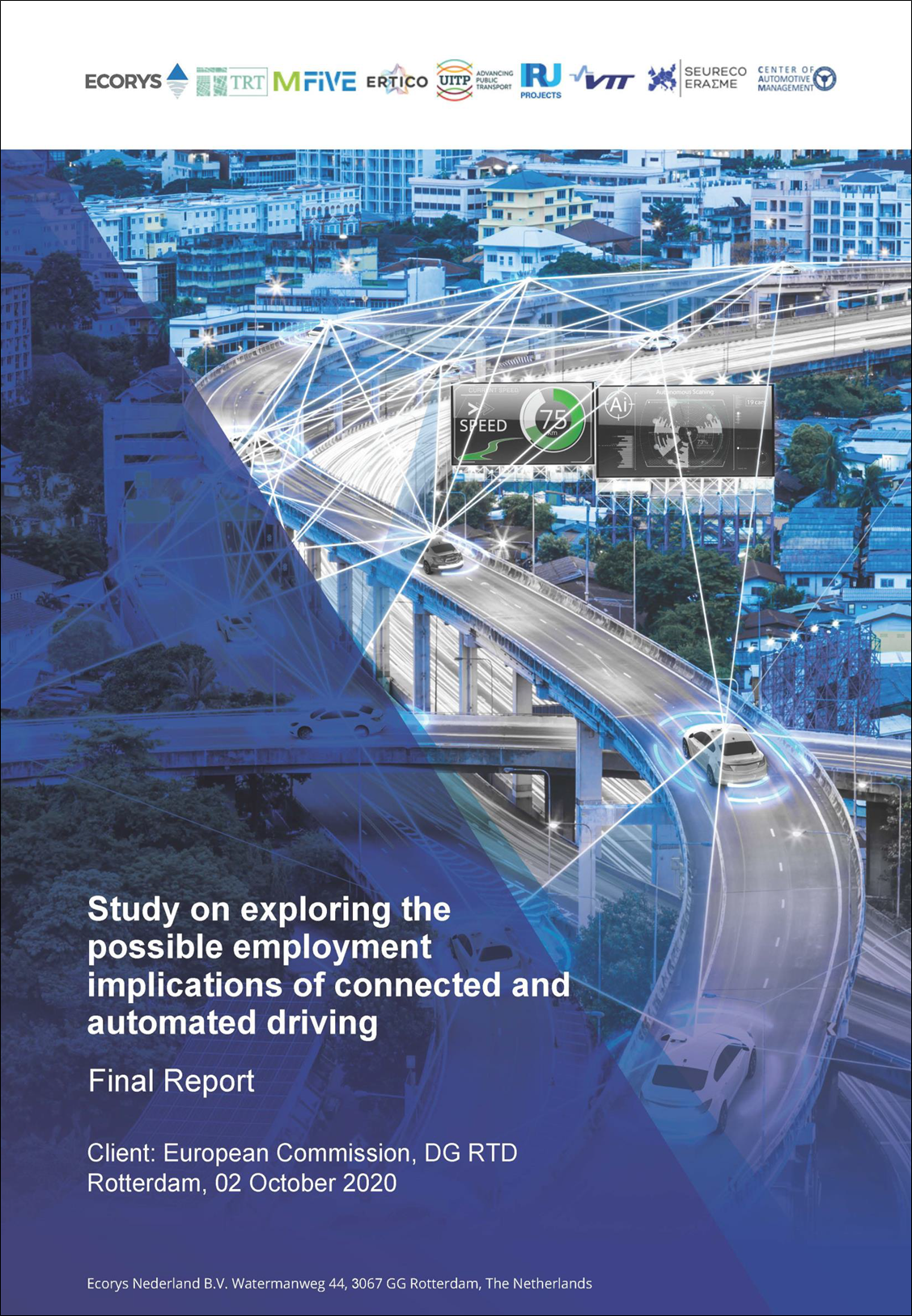
Study on employment and social impacts of connected and automated driving (CAD)

TRT together with Ecorys (lead), M-Five, VTT, SEURECO, ERTICO, UITP and IRU analysed the employment and social impacts of connected and automated driving (CAD). The 16-month study was finalised end of last year and has now been published. The study was implemented for the Directorate-General for Research and Innovation (DG RTD) of the European Commission. It provides an analysis of the short, medium- and long-term impacts of CAD on jobs, employment, skills and knowledge, as well as an investigation and elaboration of options in key policy areas in order for the European Union to take timely action. The main report presents four different scenarios outlining future CAD deployment and fleet compositions up to 2050. The main part of the report provides an analysis of the employment and social impacts along these four scenarios, highlighting expected quantitative as well as qualitative impacts. Results show likely severe social impacts on the road transport sector. In exchange with stakeholders, we developed 22 policy options to address this transition. The policy options are presented in the final part of the report. These policy options have been operationalised by adding a timeline and by describing the role of various actors with the goal of setting the groundwork for a social roadmap for CAD deployment. The supporting annexes provide additional information with more detailed findings, as well as information on the methodology used to come to these results.
11 September 2020

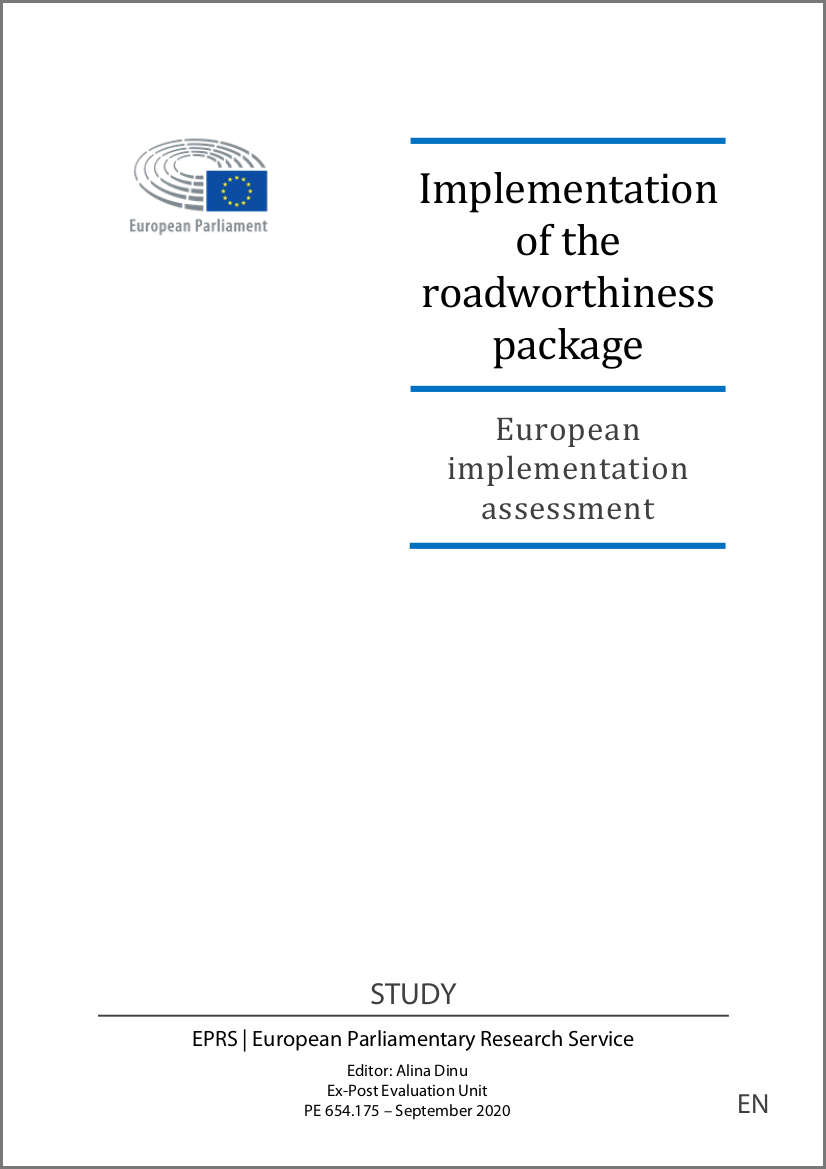
Implementation of the European roadworthiness package

This study, carried out by TRT who had lead a multidisciplinary international consortium made by OIR, Arcadia International and M&E Factory, further supported by CORTE, checks how EU Member States have transposed the package from the road safety perspective, determines whether the transposition has effectively led to the application of common standards, and check whether the national measures transposing the safety provisions of the package are sufficient and adequately shaped to achieve its safety objectives. These goals required the analysis of legal transpositions by Member States, performed by considering the national legal measures transposing the roadworthiness package as they had been notified to the EC (more than 450 documents from 27 Member States), and a direct survey among responsible authorities at national level involved 23 different organization from 21 MS completed by 7 direct interview to ministries and other national authorities. Link to the project page. The study is available here.
25 November 2019

TRT involves innovative mobility startups within the HiReach Startup Lab

The HiReach project, in collaboration with Impact Hub Vienna, has launched the HiReach Startup Lab, a Europe-wide accelerator program for mobility startups. The program is an opportunity to develop innovative solutions that address transport poverty. HiReach supports startups willing to improve the accessibility of urban and rural areas considering the needs of vulnerable citizens (low-income, women, children, elderly, migrants, etc.). The accelerator program offers startups a unique opportunity to prototype their solutions with the support of a dedicated Host Company, professional business coaching, and financial support up to 20.000 EUR. The top 5-10 startups will showcase at the ITS European Congress in Lisbon in May 2020 and during the demo day in Brussels in September 2020.
24 July 2019

Innovation Brief on City Logistics Solutions

The document, written by TRT as partner of the PROSPERITY  project, provides a background into the current state of urban logistics. It also illustrates a series of policy options and innovative solutions that could bring about change to the organization of the freight transport in cities. Link to the project page. 24 July 2019 [tw_fontawesome fa_size=”14″ fa_padding=”0″ fa_color=”#223468″ fa_bg_color=” ” fa_border_color=”#aaaaaa” fa_rounded=”0″ fa_rounded_size=”03″ fa_icon=”fa-download”] Download the report
26 June 2019

Survey on International Merchandise Transport – 2018

This paper is a summary of the surveys on international freight carried by TRT for Banca d’Italia (Italian national bank) in 2018. It includes main figures of the sample surveys carried by TRT for Banca d’Italia dating back to 1998. It is part of the balance of payments, in the section of international freight transport, in line with methodological conventions of the 6th manual of International Monetary Fund. In 2019 TRT interviewed 200 circa of the main international freight operators, with the aim to find out information regarding freight rates and ancillary costs. Moreover, market shares of carriers by nationality has been estimated. During 2018 road transport had a slight decrease of freight rates, with differences according with the reference area. Rail sector had a generalized increase on intermodal freight and a decrease in conventional. Air freight cargo had a significant increase in average costs, especially for exportation, due to the increase of demand. Maritime sector registered an average reduction of costs because of a depreciation of tax exchange between EUR and USD and because of a slowdown of world economy.
28 July 2017

Survey on the international freight transport – 2016

TRT has been commissioned by the Banca d’Italia (Italian Central Bank) to carry out a four-year survey on the international freight transport in order to: identify the unit costs of different transport modes for imports and exports; identify the components of ancillary costs; show in a matrix the abroad goods exchange; define the market share held by Italian actors in the maritime, air and rail transport sectors; estimate the turnover made by Italian ship-owners abroad. This project follows similar surveys managed by TRT since 1998, whose results are used by Banca d’Italia to estimate the Balance of Payments for the corresponding years. [tw_fontawesome fa_size=”14″ fa_padding=”0″ fa_color=”#223468″ fa_bg_color=” ” fa_border_color=”#aaaaaa” fa_rounded=”0″ fa_rounded_size=”03″ fa_icon=”fa-download”] Download the study
30 June 2017

Sustainable mobility, are we on track?

“Sustainable mobility, are we on track?” (“Mobilità sostenibile, siamo sulla buona strada?”) is a paper by Patrizia Malgieri and Marco Gatto published on SmartCity & MobilityLab n. 20 This paper gives a contribute to the reflection on transport sustainability and greenhouse gases emissions, and it compares different guidelines on policy in climate and energy sectors with the more specifics guidelines on mobility, in particular with mobility in urban areas. May-June 2017 Paper available only in Italian. [tw_fontawesome fa_size=”14″ fa_padding=”0″ fa_color=”#223468″ fa_bg_color=” ” fa_border_color=”#aaaaaa” fa_rounded=”0″ fa_rounded_size=”03″ fa_icon=”fa-download”] Download the paper
30 June 2017

La logistica tra le cascine milanesi

“Logistics in Milan farmhouse” (“La logistica tra le cascine milanesi”), paper by Giuseppe Galli and Ettore Gualandi on SmartCity & MobilityLab n. 20 This paper presents the pilot of TRT project U-TURN, acronym of “Rethinking Urban Transportation through advanced tools and supply chain collaboration”, co-financed by European Commission in Horizon 2020 strategic programme. Its aim is to identify some collaborative logistical strategies in the distribution of food in urban areas in order to optimize the food delivery activity. May-June 2017 Paper available only in Italian. [tw_fontawesome fa_size=”14″ fa_padding=”0″ fa_color=”#223468″ fa_bg_color=” ” fa_border_color=”#aaaaaa” fa_rounded=”0″ fa_rounded_size=”03″ fa_icon=”fa-download”] Download the paper