


SUMP Training and Capacity Building in EU countries
TRT, supported by a consortium of six companies (DTV Consultants, TREDIT, TIS, Stratec, Goudappel, and Eurocities), has been appointed by the European Investment Bank (EIB) to provide SUMP Training and Capacity Building activities in multiple EU countries
The primary goal of the project was to enhance the expertise of urban and regional transport planners, as well as newcomers, focusing on Sustainable Urban Mobility Plans (SUMPs) and offering centralized support for their implementation at the local and regional levels.
The project entailed a comprehensive program encompassing almost 30 training sessions and workshops in less than 2 years, covering Sustainable Urban Mobility Plans (SUMPs), National SUMP Support Programmes (NSSP), and Urban Mobility Indicators (UMI) monitoring and reporting mechanisms.
The project aimed to improve the technical and policy expertise of urban transport planners regarding SUMPs and facilitate their implementation at city or regional levels. It targeted local training for TEN-T urban nodes and small/medium-sized EU cities, alongside capacity-building workshops to assist in establishing NSSPs at the national/regional levels. This initiative was crucial for implementing the Commission Recommendation on NSSPs and the TEN-T Regulation requirements for urban nodes and Member States, bridging capacity gaps in smaller cities and ensuring national engagement and support.
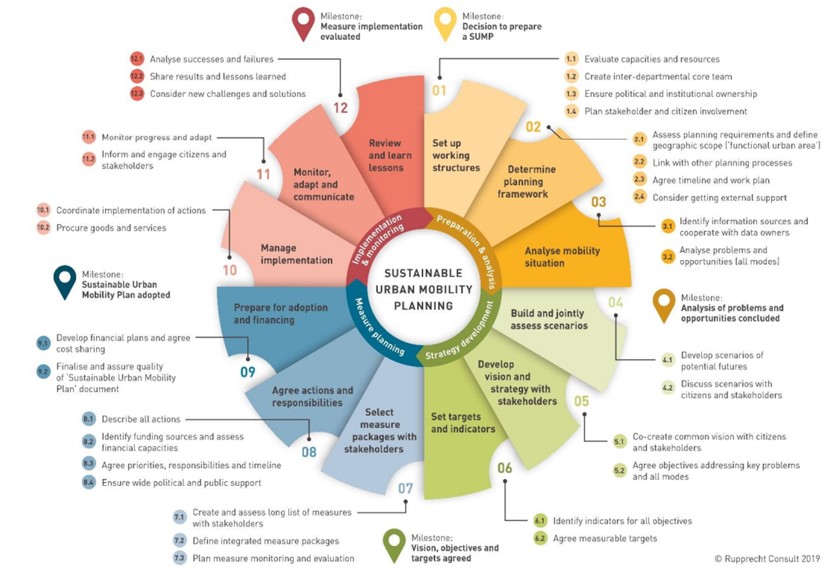
Aligned with the New EU Urban Mobility Framework, the training sessions focused on various SUMP aspects, including governance, legislation, funding, monitoring, evaluation, guidelines, methodology, education, and knowledge exchange through NSSPs. The training approach blended fundamental SUMP knowledge with the latest mobility, technology, and societal developments.
The ultimate goal of the project was to strengthen SUMP implementation and governance across Europe by addressing key aspects of modern mobility planning, including monitoring tools, legal frameworks, and financial commitment, while tailoring activities based on Member States’ specific needs and interests.
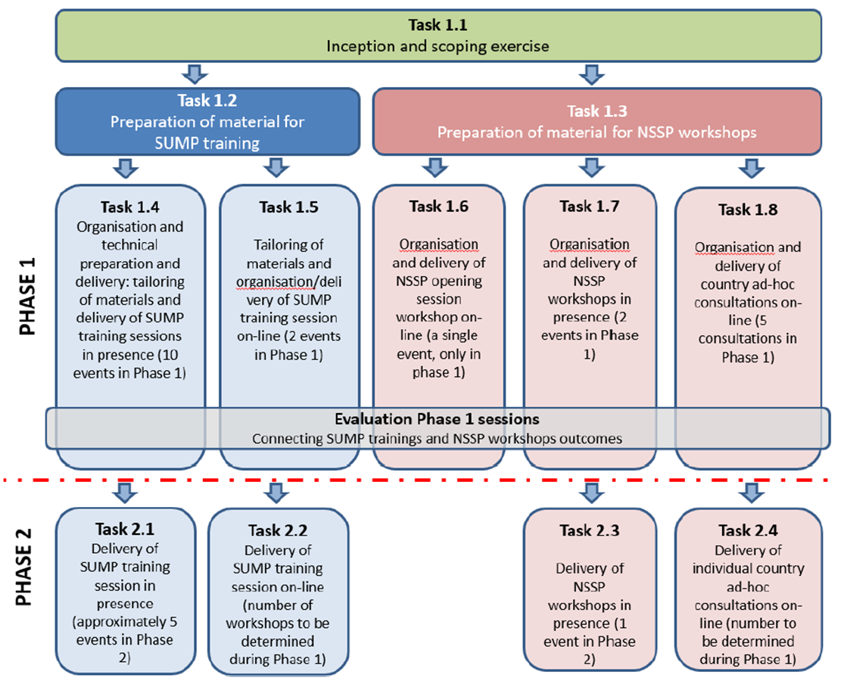
The SUMP training and NSSP workshops were delivered by 4 key experts: Tom Rye, Christiaan Kwantes, Kristina Gaučė, and Aljaž Plevnik. In addition, they were supported by a pool of Non-Key Experts with a vast experience in the different fields of the urban mobility domain.
The SUMP trainings covered a wide range of topics:
| CORE MODULES |
|---|
| Basics of SUMP methodology and practice |
| The link between Strategic Plans, Programming, Pipeline and project preparation |
| Urban nodes and the interface between local and strategic transport |
| ELECTIVE MODULES |
|---|
| Organisational and institutional aspects |
| Multimodal plan scenario building in SUMPs |
| Indicators, targets and monitoring |
| Citizen/Stakeholder engagement and communication |
| SUMPs for small and medium-sized cities |
| Demand and Accessibility analysis through the SUMP |
| Transport decarbonisation |
| Environmental aspects |
| Climate change adaptation and resilience |
| Collective passenger transport |
| Active modes and micromobility |
| Freight and logistics |
| Demand management |
| Spatial planning |
| Road safety and street design |
| Inclusive and accessible mobility |
The NSSP workshops encompassed several aspects, including the introduction of NSSP concepts, EC guidance, guest speakers, Q&A sessions, breakout group discussions, systemic barriers, national legislations, SUMP financial support, National SUMP platforms, SUMP guidance, and monitoring and evaluation at the national level.
The first phase of the project lasted from September 2024 and was completed in June 2025, which saw the organisation of 12 training sessions on SUMPs (10 of which were held in-presence in Romania, Czech Republic, Belgium, Portugal, Spain, Hungary, Cyprus, Croatia, Ireland, Greece, and 2 online for Lithuania and Italy), and 4 workshops on NSSPs. The second phase of the project involved the organisation of a further 10 training sessions on SUMPs in other EU Member States (9 trainings were held in-presence in the Netherlands, Malta, Finland, Latvia, Estonia, Slovenia, Slovakia, Poland, Sweden, and 1 online for France), from September 2025 until June 2026. In total, the training programme was attended by over 700 participants from around 200 urban nodes, as well as over 80 national representatives from 25 Member States.


Through this project, the Consortium further expanded its knowledge and expertise in a wide range of SUMP aspects, including consultancy, policy guidance, training, communication, and networking in the field of urban mobility, established partnerships and communication channels, and a deepened its understanding of common issues and barriers encountered in SUMPs development and implementation.
The training material is available on the European Investment Bank (EIB-JASPERS) website at the following link: https://jaspers.eib.org/knowledge/events/sustainable-urban-mobility-plan-sump-training-sessions